
Emily Wagner didn’t set out to study algae twice.
The University of Toledo senior, an environmental sciences major from Dearborn, Michigan, spent her first two college summers in the lab of Dr. Thomas Bridgeman, professor and director of the University’s Lake Erie Center, studying the harmful algal blooms that plague the lake each year.
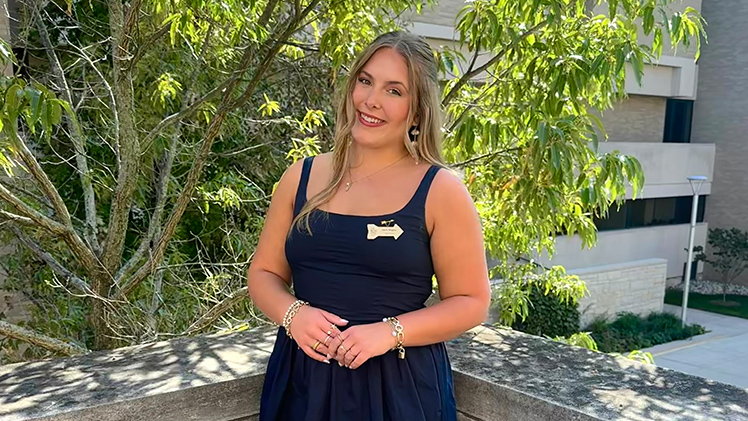
Emily Wagner, a senior in environmental sciences, turned a rejection into a return offer and a childhood aquarium visit into a summer researching coral reef restoration in the Florida Keys.
This past summer, she found herself hundreds of miles away in the Florida Keys and, almost by coincidence, back on the subject of algae.
“It all leads back to the algae,” Wagner said with a laugh.
A Long Road to Toledo
Wagner’s path to UToledo wasn’t a foregone conclusion. She toured 15 schools across the Midwest and Florida before choosing The University of Toledo, and what won her over wasn’t a single feature so much as a feeling.
“The faculty were great and so supportive,” she said. “They were interested in me and my goals, and I knew I had found my place.”
She chose environmental sciences over marine biology for the practical reason that a landlocked state doesn’t make for an easy entry into a competitive, ocean-focused field, but that didn’t stop her from finding her way to the water anyway.
An Internship Years in the Making
This summer, her path led her to Mote’s Elizabeth Moore International Center for Coral Reef Research & Restoration in Summerland Key, Florida, where she worked under the mentorship of Dr. Jason Spadaro and staff biologists at the Grazer’s Lab.
The lab’s focus was raising Caribbean king crabs — a native reef grazer — to a size where they can be outplanted onto restoration reefs alongside coral. The crabs help control the overgrowth of macroalgae, easing one of many stressors on coral that Wagner calls “the most sensitive animals on planet Earth.”
Getting there took persistence. Wagner first applied as a sophomore and didn’t get the internship, which went to an older student who needed it to graduate. But her interviewers told her to stay in touch, and she did.
“They said, ‘We have been thinking about you all year. We wanted you,’ ” Wagner recalled of her eventual acceptance.
The connection to Mote traced back further still, to a rainy-day visit to the aquarium’s Sarasota campus during a family vacation years earlier, when Wagner struck up conversations with staff and volunteers and came away certain she wanted to work there one day.
Finding Her Footing in the Field
The summer brought more than lab work. Wagner attended research conferences, met scientists from National Oceanic and Atmospheric Administration and finished the open-water scuba certification.
It also reshaped her sense of what a career in marine science could look like. Where she once envisioned a straightforward path into research and graduate school, Wagner is now weighing time on a field team against a longer-term interest in public outreach and science education.
“There are so many cool jobs that exist,” she said. “Now I’m thinking, I just want to do everything.”
Through it all, she credits UToledo’s emphasis on experiential learning as being invaluable.
“It’s the networking and meeting people,” she said. “Especially in these kinds of fields, it’s really all who you know.”
Leadership Beyond the Lab
Back on campus, Wagner serves as chapter president of Pi Beta Phi. She’s also been involved with the Society of Environmental Advocates and the women’s ministry group Soul Purpose. She chose those three commitments deliberately, she said, to cover academic, faith-based and social needs without overextending herself.
“Get involved, but be intentional about it,” Wagner advises future Rockets. “Don’t have too much on your plate.”
One campus project brought her worlds in and out of the classroom together at once: a campus cleanup and native-plant restoration at the memorial for Melissa Hurstrom, a Pi Beta Phi sister who passed away several years ago.
Wagner connected her chapter with Dr. Todd Crail, a Distinguished University Lecturer in the Department of Environmental Sciences who advises the Greening UToledo through Service or GUTS program, to turn the cleanup into an alumni event that brought back sisters who had known Hurstrom.
Crail, Wagner said, has been a constant presence throughout her time at UToledo. “Even through the smallest, most minor things, I sent him an email and he’s replying in 15 minutes,” she said.
Crail gives credit to Wagner for perseverance.
“Emily came in with a strong sense of who she was and a clear goal: to conserve marine ecosystems,” he said. “What she has done so successfully is accept opportunities that were obliquely related to that goal, while realizing that ‘no’ is actually ‘not yet.’
“She continues to get closer to the mark, refining the next steps she would like to take, and I cannot wait to see what the future holds for her.”
Looking Ahead
As she starts her senior year, Wagner is still weighing exactly where her degree will take her. It could be a field team, graduate school, public education and outreach, but she’s confident in the foundation she’s built.
Her advice to incoming students echoes the approach that’s carried her from Lake Erie to the Florida Keys: get involved, connect with the people who believe in you, and don’t be afraid to reapply.
