
Four bioengineers who developed their invention as students at The University of Toledo have been awarded a U.S. patent for a device that combines two products many women currently have to use separately: a pessary and a menstrual cup.
The U.S. Patent and Trademark Office issued Patent No. 12,672,979, “Combined Pessary and Menstrual Cup,” this month to Lauren Coy, Tara Dobric, Morgan Folley and Joelle Gallais, who developed the device during their time as students in UToledo’s bioengineering program.
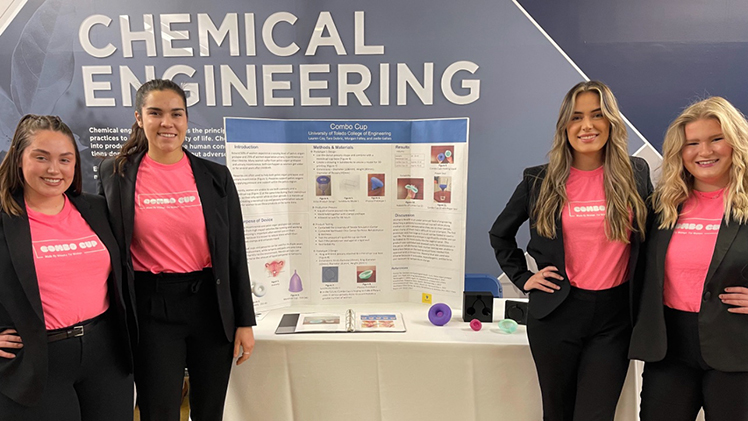
From left, Lauren Coy, Joelle Gallais, Morgan Folley and Tara Dobric present their senior capstone bioengineering project that went on to earn a U.S. patent this summer.
The device is designed for women with pelvic organ prolapse, a common condition in which weakened pelvic muscles and tissue allow the bladder, uterus or rectum to shift out of place and press into or out of the vagina.
Pessaries, ring- or disc-shaped devices inserted into the vagina to support these organs, are a widely used nonsurgical treatment, but many women choose to remove them and use a tampon or menstrual cup during their periods. Pessaries are often fitted, inserted and removed by a medical professional.
The UToledo student team’s invention combines the supportive function of a pessary with the fluid-collecting function of a menstrual cup in a single device, allowing it to support the bladder while also managing period flow. The design is biocompatible, hypoallergenic and flexible, and it is intended to be durable enough for repeated use without requiring a clinician to remove or clean it.
“As a group we were interested in women’s health as it is underfunded and under researched globally,” said Dobric “This idea came about after speaking with pelvic floor physical therapists regarding issues that women face.”
While the project was a rewarding hands-on experience, the team didn’t set out to become recognized inventors.
“I don’t think anyone on the team assumed we would get a patent while at The University of Toledo,” Folley said. “As we started researching, creating the first prototype and getting good feedback, it started to click that we might be able to. We are very grateful for the help of the technology office as we did not know where to start.”
“It was also just fun working with a group of dedicated individuals on a project like this,” Gallais said. “Hopefully, the product will make a difference in the future.”
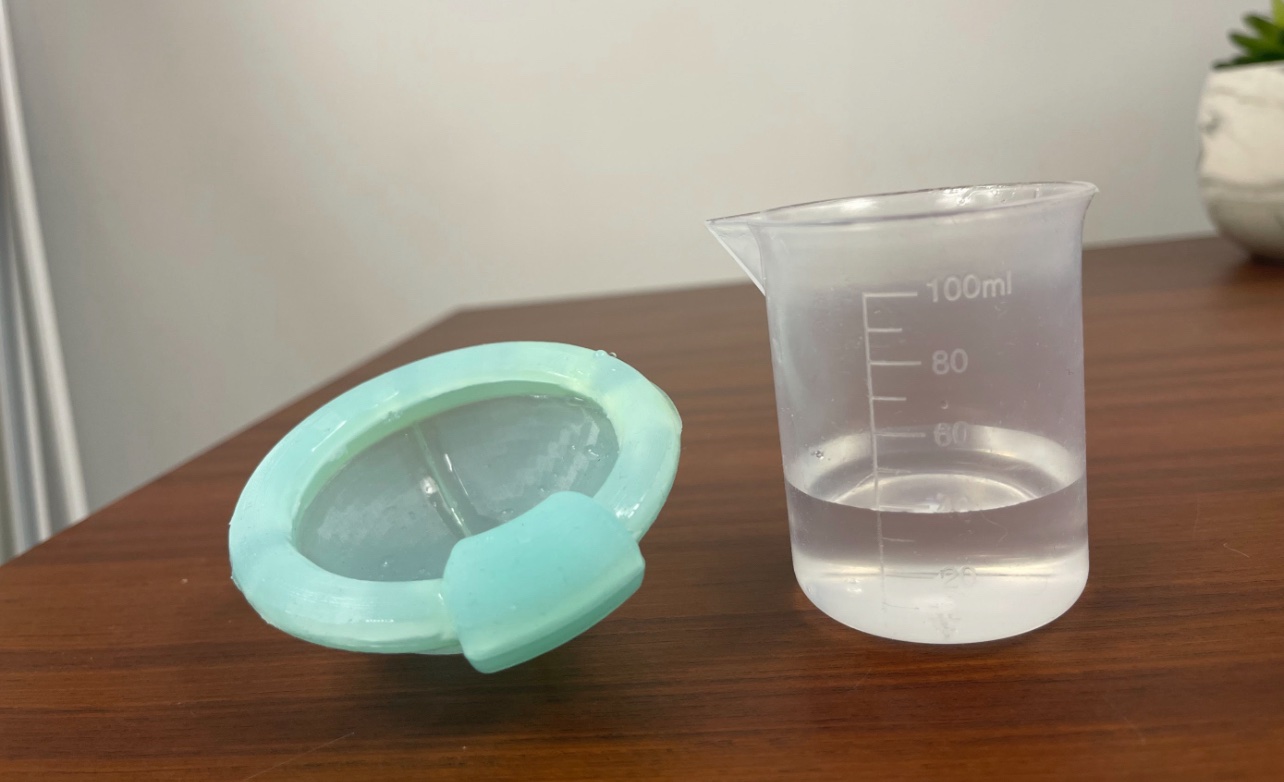
The Combined Pessary and Menstrual Cup is a device designed for women with pelvic organ prolapse, a common condition in which weakened pelvic muscles and tissue allow the bladder, uterus or rectum to shift out of place and press into or out of the vagina.
Clinical testing is the next step in the process and, for that, the four bioengineers are working with UToledo’s Technology Transfer Office to test the interest of companies that might license the device.
Now that they have seen the project through to the award of a U.S. patent, the women look back and see valuable insights gained along the way.
“It is very exciting for all of us as it’s something we didn’t even think of when we first started at the University,” Coy said. “We also learned a lot going through the project that we can use in our careers.”
The invention adds to a growing list of student-led patents to come out of the College of Engineering’s senior capstone project.
All four inventors have graduated and launched their careers at companies across the United States and Canada.
Coy completed her degree in 2022 and is now a senior process validation engineer at INCOG BioPharma Services in Indiana. After graduating in December 2022, GalIais joined Zimmer Biomet in Montreal in a quality engineering role.
Another December 2022 graduate, Folley works as a senior applications engineer at Shukla Medical in St. Petersburg, Florida. Dobric earned her degree in 2023 and is now working as a biomedical equipment technician at TRIMEDX in Detroit.
