
Harmful algal blooms pose serious threats to people, animals and the environment.
So The University of Toledo’s Dr. Jeanine Refsnider counts it as a positive discovery that northern map turtles tend to steer clear, as she and an undergraduate collaborator recently reported in the peer-reviewed Journal of Great Lakes Research.
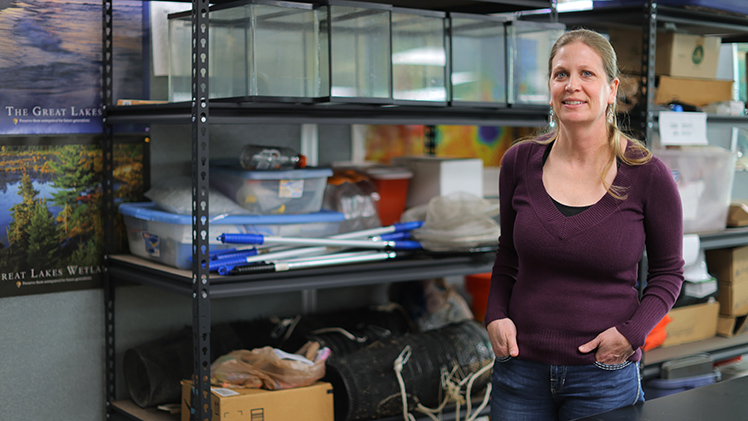
Dr. Jeanine Refsnider, a professor of ecology, utilized acoustic and satellite telemetry to determine that northern map turtles steer clear of blooms in western Lake Erie.
“It wasn’t quite what we were expecting to see,” said Refsnider, a professor in the College of Natural Sciences and Mathematics’ Department of Environmental Sciences. “We don’t know if they leave because of the algal bloom or if the bloom just coincides with a time of year when they head to a different habitat, but it’s nice they seem to be relatively safe.”
The discovery reflects a new field technique for Refsnider, a herpetologist with years of experience using radio telemetry to track turtles through the forests and wetlands of the Oak Openings Region. In tracking the movements of 10 female northern map turtles from a nesting beach in western Lake Erie in 2022, though, Refsnider and Di’Carlo Jackson, then an undergraduate student at Park University participating in the National Science Foundation-supported Research Experiences for Undergraduates program at UToledo, explored the potential for acoustic and satellite telemetry.
Acoustic telemetry allows scientists to track the movements of their subjects, each of which is affixed with an acoustic transmitter, via a network of acoustic receivers. Locally these receivers are strategically positioned throughout the Maumee River and Lake Erie under the Great Lakes Acoustic Telemetry Observation System.
Acoustic telemetry is more commonly used with fish, including the sturgeon studied by Dr. William Hintz, an associate professor in the Department of Environmental Sciences.
Satellite telemetry, meanwhile, transmits data from specialized transmitters to satellites.
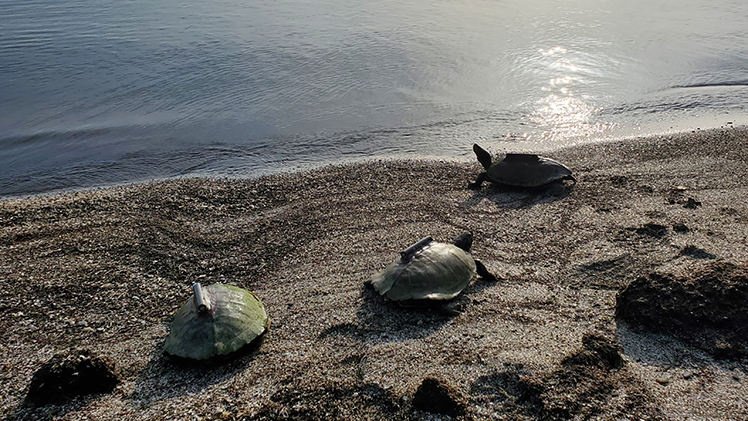
Researchers affixed lightweight acoustic and satellite transmitters to the shells of northern map turtles in 2022. The transmitters then relayed valuable data on the whereabouts of the turtles, including as an algal bloom peaked in western Lake Erie in August.
“This was kind of a proof of concept,” Refsnider said. “It ended up working well that we used both acoustic and satellite telemetry because they both worked in very different situations. Acoustic worked well when the turtles were underwater, whereas satellite picked up when they were up a tributary and farther away from the receivers.”
The data the researchers collected through both techniques allowed them to map the movements of the turtles, including their extensive travel up a tributary — a range of 6 to more than 13 miles. The finding is valuable for informing how herpetologists understand this species and its interactions with its habitat over the course of a year, particularly given the comparatively little research already published on lake rather than river habitats.
Refsnider and Jackson were particularly keen to learn to what degree northern map turtles were exposed to harmful algal blooms, which emerge annually in the western basin of Lake Erie and typically peak in August. UToledo is a leader in research related to water quality and harmful algal blooms, with faculty across academic disciplines at the forefront of efforts to monitor, predict, manage and ultimately prevent blooms.
That work has drawn national recognition: The Association of Public and Land-grant Universities awarded UToledo its Public Impact Research Award in 2022 in recognition of the University’s contributions to the region through water quality research.
“The turtles headed into open water after they nested, but we didn’t detect any in Lake Erie after late July,” Refsnider said. “By then they had moved upstream to tributaries or adjacent marshes, where they overwintered before they returned to the same nesting beach the following spring. So we have no reason to think that the turtles were exposed to algal toxins by the time the bloom was peaking in August.”
