
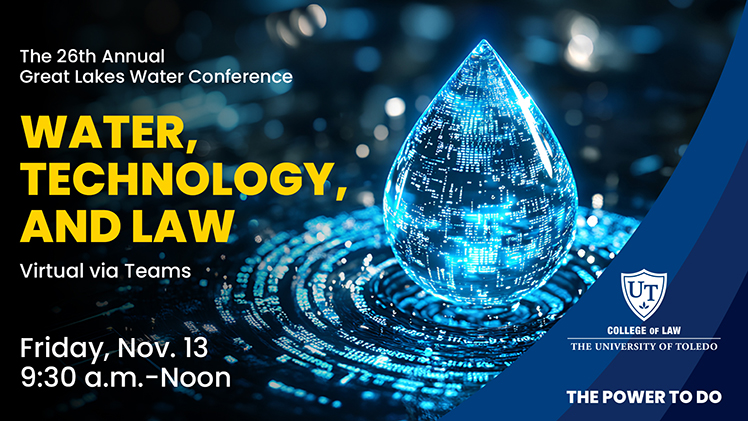
The University of Toledo will host four national panelists to explore legal policy pertaining to data centers and their increasing demand for water, among other topics at the intersection of water, technology and law, at the 26th Great Lakes Water Conference on Friday, Nov. 13.
“Water, Technology and Law” will be presented as a live webinar from 9:30 a.m. to noon. Online registration is required by Tuesday, Nov. 10, and registrants will receive an email with a link to the virtual conference a few days before the event.
 Registration for those seeking continuing legal education (CLE) credits is $65. Registration for all others is free.
The University of Toledo College of Law and its affiliated Legal Institute of the Great Lakes sponsor the annual Great Lakes Water Conference, which explores timely water issues of importance to the region and the nation. This year’s panelists will bring expertise in law, public policy and civil and environmental engineering to discussions about technological developments that present both challenges and opportunities for the safety and security of water resources.
Examples will include artificial intelligence, which is supported by a data center development boom that demands enormous amounts of water to cool processors, as well as groundwater and other monitoring technology that provides new ways to understand water consumption patterns.
“The impact of novel technological developments on our water resources is hard to overstate,” said Evan Zoldan, the director of the Legal Institute of the Great Lakes. “Some of these technological developments increase the demand for water, straining this limited natural resource. Other technological developments make it possible to protect water, for example, by making it easier to monitor water usage or identify infrastructure weaknesses. This year’s water conference will bring together experts on water, technology and law to address these and other ways that technological developments impact the safety and security of water.”
The Legal Institute of the Great Lakes is a multidisciplinary research center within the College of Law. Founded in 1993, it supports research, maintains publications and sponsors conferences on legal, economic and social issues of importance to the Great Lakes region of the United States and Canada.
For more information, including a conference agenda and a link to register, go to the College of Law’s Great Lakes Water Conference website.
