
Dr. Nina Schor, a pediatric neurologist, cancer researcher and former senior leader at the National Institutes of Health, will be the featured speaker at this year’s S. Amjad Hussain Visiting Lecture in Medical Humanities.
Now in its 16th year, the lecture will be held at 5:30 p.m. on Thursday, Oct. 23, in Health Education Building Room 110 on The University of Toledo Health Science Campus.
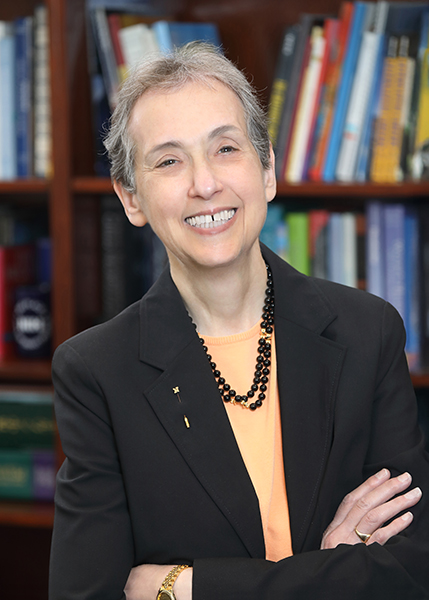
Dr. Nina Schor, who formerly oversaw internal research at the National Institutes of Health, will speak at UToledo on Thursday, Oct. 26.
The event is free and open to the public, but RSVPs are requested by Monday, Oct. 20. Registration can be completed via a webform accessible on the College of Medicine and Life Sciences website.
Schor’s resume reflects the accomplishments of a distinguished physician-scientist.
She holds a Ph.D. from Rockefeller University and an M.D. from Cornell, and has spent more than 30 years in academic medicine, primarily focusing on discovering new therapies for neuroblastoma, a cancer that begins in immature nerve cells. More recently, she served nearly eight years at the NIH, including a term as the deputy director for intramural research, a role in which she oversaw the agency’s internal research efforts.
But Schor also describes herself as a poet and wordsmith who cares as much about the sound and feeling of words as she does their intrinsic meaning.
In her upcoming lecture at UToledo, she will explore how she bridges the worlds of medicine and the arts — and how embracing the humanities can both provide physicians an antidote to burnout and better equip them for having difficult conversations with their patients.
“I think that art and science are part of one very beautiful continuum. Each brings a richness to the other that all of us really benefit from,” she said. “The subject of my talk is going to focus primarily on how one can use the writing of poetry as a personal outlet but also so one can facilitate difficult conversations with patients and families.”
Schor’s academic career began with a 20-year stint at the University of Pittsburgh, where she served as the Carol Ann Craumer Professor of Pediatric Research, chief of the Division of Child Neurology in the Department of Pediatrics and associate dean for medical student research. She later moved to the University of Rochester as the William H. Eilinger Chair of the Department of Pediatrics and pediatrician-in-chief of the Golisano Children’s Hospital.
In 2018 she left Rochester to become deputy director of the National Institute of Neurological Disorders and Stroke, and in 2022 was appointed to lead the NIH Intramural Research Program, overseeing some 1,200 principal investigators and more than 4,000 postdoctoral fellows.
She stepped down from the NIH this fall, returning to the University of Rochester as professor of pediatrics, neurology and neurobiology and chair emerita of the Department of Pediatrics.
In addition to publishing 100-plus peer-reviewed scientific papers, Schor also has published several poems, including a number featured in the medical journal Neurology.
While some may be surprised to see a physician dabbling in the humanities, it’s a natural connection to Schor.
“Being a physician involves not only understanding the science and the medicine but being able to relate to and explain things to other people whose backgrounds may be very, very different from your own,” she said. “Research also is an intrinsically social enterprise. Without discussion and exchange and consensus-building, there can be no research.”
Beyond the value of effective communication in the lab or clinic, Schor said writing — and particularly poetry — can provide an important personal outlet.
“Physicians and researchers are increasingly experiencing burnout for a whole slew of reasons,” she said. “You’re almost like a capacitor storing up that intensity all week long. Somehow that has to discharge somewhere. How much better that it discharges in an artful form rather than anger or desperation? That pop-off valve is a very important one.”
The S. Amjad Hussain Visiting Lecture in Medical Humanities was created in honor of Dr. Hussain, professor emeritus of cardiovascular surgery and humanities, a former member of the UToledo Board of Trustees and a columnist for The Blade.
