
Members of the International Joint Commission’s Great Lakes Water Quality Board visited The University of Toledo Lake Erie Center this month to learn about ongoing research addressing harmful algal blooms, road salt pollution and drinking water challenges affecting the Great Lakes region.
Approximately 22 U.S. and Canadian board members participated in the afternoon visit to the center, UToledo’s freshwater research and education facility located along Maumee Bay in western Lake Erie.
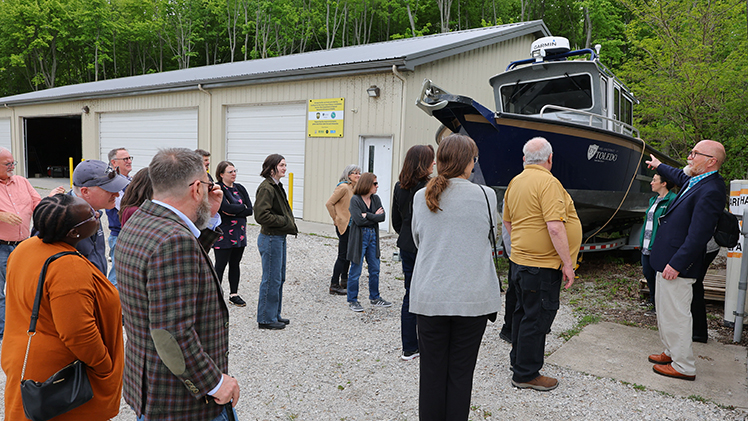
Dr. Thomas Bridgeman, far right, director of the UToledo Lake Erie Center and a professor in the Department of Environmental Sciences, leads members of the International Joint Commission Water Quality Board on a tour of the Lake Erie Center facilities in Oregon, Ohio.
The visit included a facilities tour and research presentations highlighting work examining harmful algal blooms, nutrient runoff, freshwater ecosystem health and the impacts of road salt contamination on regional waterways. Discussions also focused on the challenges facing drinking water utilities that rely on Great Lakes water sources.
Mining UToledo Research and Expertise
Under the binational Great Lakes Water Quality Agreement, the International Joint Commission and its advisory boards advise US and Canadian governments’ coordinated efforts to reduce pollution, protect ecosystem health and safeguard drinking water resources relied upon by millions of people in both countries.
The board’s visit is an acknowledgement of the established expertise of Lake Erie Center researchers and their long-standing contributions to understanding and protecting freshwater ecosystems.
“Part of the Great Lakes Water Quality Board’s job is to alert the IJC and both governments to emerging issues,” said board U.S. co-chair Molly Flanagan. “What stands out is the Lake Erie Center’s collaborative and innovative science and applied research helping decision makers anticipate, prepare and respond to complex water quality challenges.
“Solutions-focused, interdisciplinary science from institutions like UToledo’s Lake Erie Center is essential to inform our board’s advice to the IJC and governments to help advance Great Lakes protection,” added Flanagan, who also serves as Great Lakes senior program officer at the Fred and Barbara Erb Foundation.
During the visit, researchers highlighted work examining harmful algal blooms, nutrient runoff, freshwater ecosystem health and the impacts of road salt contamination on regional waterways. Discussions also focused on the challenges facing drinking water utilities that rely on Great Lakes water sources.
A Decade of Research Rooted in Crisis
The IJC Great Lakes Water Quality Board visit came as the Lake Erie Center continues to expand interdisciplinary research tied to drinking water safety, climate resilience and ecosystem restoration throughout the Great Lakes region.
The sense of urgency behind the center’s water quality research traces directly to 2014, when a harmful algal bloom in western Lake Erie contaminated the Toledo Water Treatment Plant’s raw water intake with the toxin microcystin, forcing a three-day “Do Not Drink” advisory. The crisis affected roughly half a million residents and prompted UToledo to rapidly organize a broad, interdisciplinary response.
In the decade since, UToledo researchers have developed more sophisticated bloom monitoring and prediction tools, installed a real-time algae sensor at the city of Toledo’s lake intake — the first such installation in the country — and deepened partnerships with water utilities across northwest Ohio to optimize treatment strategies.
UToledo experts have also expanded their focus to address the compounding threat of road salt contamination, which has emerged as a significant and often underrecognized stressor on Great Lakes water quality and freshwater biodiversity.
