
University of Toledo astronomers are advancing our understanding of a star’s earliest stages of development — and creating stunning images along the way.
Dr. Tom Megeath, a Distinguished University Professor in the Department of Physics and Astronomy, is the principal investigator on the observation program that yielded the
European Space Agency’s James Webb Space Telescope Picture of the Month in June.
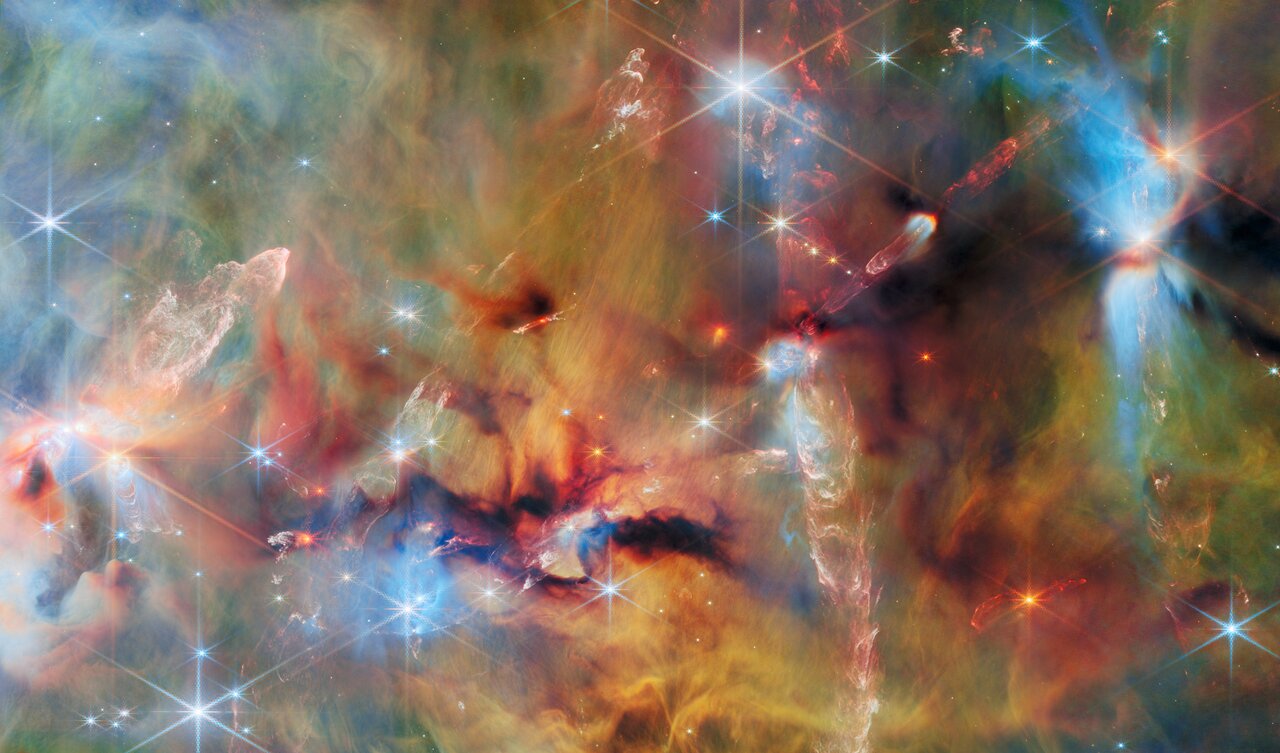
The James Webb Space Telescope captured this image of a star-forming cloud of gas and dust in the constellation Orion, which was shared widely by the European Space Agency. CREDIT: ESA/Webb, NASA & CSA, T. Megeath, M. Zamani (ESA/Webb).
The image depicts a star-forming cloud of gas and dust in the constellation Orion.
Megeath and his team of international collaborators directed the telescope’s near-infrared camera to this corner of the cosmos to investigate processes related to protostars, which are balls of gas that increase rapidly in temperature and mass during a relatively short stage in the life cycle of a star. Several UToledo graduate and undergraduate students have collaborated on the ongoing analysis of the resulting data.
The UToledo-led team was allocated nearly 200 hours to use the James Webb Space Telescope, accounting for the third largest observing program of its cycle and advancing an impressive record of engagement with some of the most advanced terrestrial observatories and space-based telescopes at UToledo’s Ritter Astrophysical Research Center.
