
Are box turtles in worse shape than herpetologists thought?
University of Toledo researchers raise the question in new research published in the peer-reviewed journal Ecology and Evolution. Analyzing years of field data collected on populations of two turtle species in northwest Ohio and southeast Michigan, the article points to evidence of concerning rates of inbreeding among eastern box turtles compared to spotted turtles — a surprise in part given that it’s the latter, not that former, that’s currently under review for protection under the Endangered Species Act.
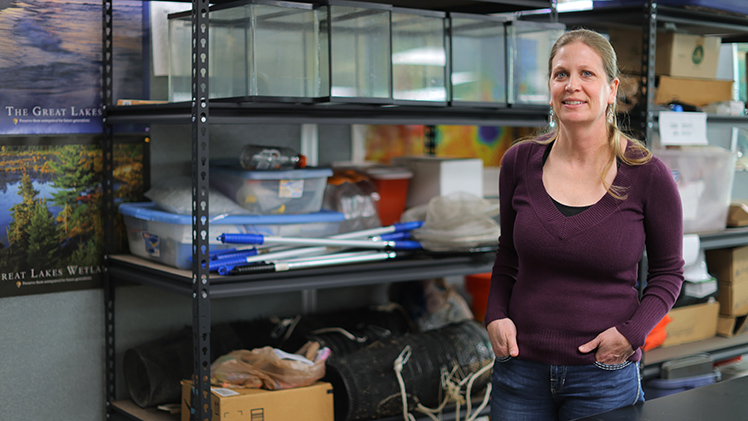
Dr. Jeanine Refsnider studies how species respond to environmental changes as an associate professor in UToledo’s Department of Environmental Sciences.
Dr. Jeanine Refsnider led the research as an associate professor in the College of Natural Sciences and Mathematics’ Department of Environmental Sciences.
“We were expecting to see inbreeding effects in our spotted turtle populations because of a few factors that you would think would predispose them to it. They generally have smaller and more isolated populations compared to box turtles, and individuals tend to stick closer to home,” Refsnider said. “Instead we found no evidence of inbreeding in spotted turtles and concerningly high levels of inbreeding in all three of our box turtle populations.”
Refsnider speaks with expertise borne out of years of experience using radio telemetry to track turtles through the regional forests and wetlands of the Oak Openings Region. Her Ecology and Evolution research reflects field data on the reproductive success of three populations of spotted turtles and three populations of box turtles that a team of undergraduate and graduate students and field technicians collected beginning in 2018.
The work was supported by the Ohio and Michigan Departments of Natural Resources.
Researchers tagged and then tracked the turtles in addition to obtaining blood samples — challenging work, according to Paige Madden, who assisted as a field technician after she completed a bachelor’s degree in environmental sciences in 2018. In addition to unmanaged terrain, unpredictable weather and the inevitable equipment malfunctions, the team had to contend with the cryptic nature of the subjects.
“In some cases, you could be standing directly on top of a turtle hidden in the leaves and have no idea,” Madden recalled.
But the work was also rewarding.
When Madden later graduated with a master’s degree in ecology and organismal biology in 2023, she drew on the data she helped to collect and analyze for a master’s thesis evaluating nesting, behavioral and reproductive success trends of regional box and spotted turtle populations. She’s also a co-author on the article in Ecology and Evolution, joining Sarah Carter and Austin Hulbert, who have also since graduated with master’s degrees.
“Processing years of raw data feels like putting together a complicated puzzle that in the end leaves you feeling fulfilled and inspired,” said Madden, who went on to work as an environmental specialist for the city of Toledo and now in environmental emergency response and administration in Colorado.
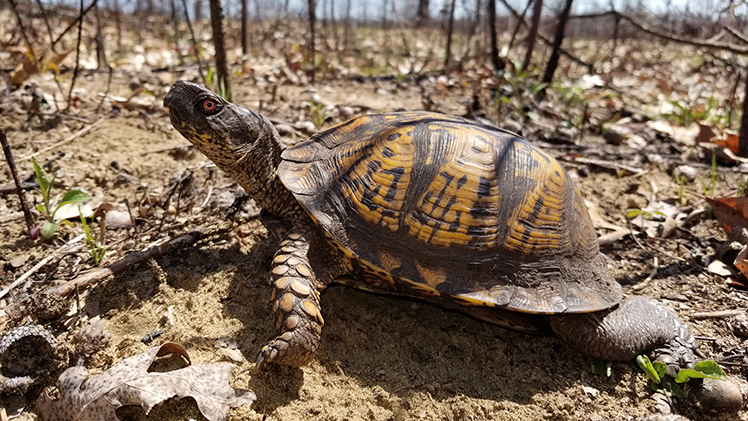
UToledo’s Dr. Jeanine Refsnider led research suggesting an inbreeding depression among box turtle populations in northwest Ohio and southeast Michigan.
The field data the team collected has yielded several publications in academic journals, most prominently an analysis of factors that predict clutch and hatchling survival in Frontiers in Ecology and Evolution. By focusing on inbreeding, the most recent analysis explores a phenomenon of concern to ecologists for its link to population decline.
“When individuals mate with close relatives, the population starts to lose genetic diversity. That can lead to an inbreeding depression, which is when we see reduced overall fitness of a population’s offspring,” Refsnider said. “Over time each generation becomes less likely to reproduce, and you end up with an even smaller population that’s even more closely related. It’s a spiral that we call an extinction vortex.”
When researchers genetically analyzed the blood samples and considered their results alongside reproductive success data for each population of box and spotted turtles, they found that local box turtle populations had considerably lower egg-hatching and hatchling survival rates than spotted turtles and may be experiencing an inbreeding depression.
One explanation reflects the role of habitat loss and fragmentation, which researchers hypothesize is more impactful for box turtles than spotted turtles because it obstructs the ability of males to leave home and mate outside their gene pool.
Male-biased dispersal patterns are characteristic of box but not spotted turtles.
Refsnider said the research also underscores the importance of leaving turtles in the wild.
“We see that people take them from their habitats because they think they’re good pets,” she said. “But the problem is that they’re wild animals from relatively small populations. So taking one turtle out of the wild could be something like 5% of an entire population.”
