
For more than a decade, researchers have been exploring the potential of a hormone called oxytocin to help individuals with autism spectrum disorder improve their social skills.
So far, though, the results of that work have been as intriguing as they have inconclusive.
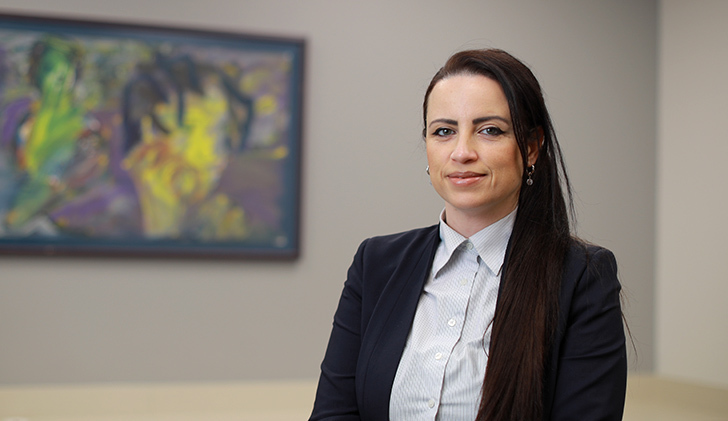
Dr. Elissar Andari, an assistant professor in the Department of Neurosciences and Psychiatry, has published a new paper showing how the hormone oxytocin affects brain function in individuals with autism spectrum disorder.
“This idea generated a lot of excitement, but long-term trials yielded inconsistent results,” said Dr. Elissar Andari, an assistant professor in the Department of Neurosciences and Psychiatry at The University of Toledo. “Some studies have shown a benefit. Some have reported no benefit at all. We went from seeing a lot of enthusiasm about oxytocin to it being almost dismissed as a potential therapeutic agent for autism.”
A newly published clinical trial led by Andari, however, may help to revive some of that interest.
Andari and her colleagues, which included researchers at Emory University and the University of Michigan, studied how a placebo and three different doses of oxytocin affected brain function in 30 individuals with autism spectrum disorder.
Our brains function not only by having dedicated areas that control specific functions but by the extensive network of connections between those areas.
In autism spectrum disorder, those networks are connected differently than what’s seen in neurotypical individuals. In some cases, Andari said, brain networks are too active. In others, they aren’t as active as they should be.
Those differences, researchers believe, can lead to some of the challenges individuals with autism spectrum disorder experience, such as difficulties interpreting non-verbal communication and picking up on social cues, or engaging in repetitive behaviors.
Using a functional MRI to measure resting brain activity, researchers found clear evidence that oxytocin, particularly at higher dosages, appeared to normalize those network connections, particularly in empathy, salience and reward networks.
The results were published the Nature journal Neuropsychopharmacology.
“We wanted to take a really clean, data-driven approach to understanding how oxytocin affects specific areas of the brain,” Andari said. “This isn’t a flashy study, but it provides real evidence on what oxytocin is doing in the brain, and what dosages may be most effective.”
Oxytocin is perhaps most familiar as the brand name drug Pitocin, which is prescribed to pregnant women to induce labor and promote lactation. But the hormone also plays an important role in social bonding.
Researchers have shown that many — though not all — individuals diagnosed with autism spectrum disorder have lower levels of oxytocin in their blood compared to neurotypical individuals. Some people with autism also have deficits in their oxytocin receptor system.
That knowledge made oxytocin a popular target of study for autism researchers, including Andari, who was the lead author of a highly influential 2010 study that showed an inhaled dose of oxytocin could help improve social behaviors in individuals with autism.
In the 15 years since, there have been scores more papers on the subject but the results from that research have been contradictory. When one study shows a positive effect, another comes along refuting it, including a large-scale study funded by the National Institutes of Health that found oxytocin had no impact on social functioning in children with autism spectrum disorder.
That paper, which came out in 2021, cooled some of the enthusiasm in the field of oxytocin research.
Andari, however, says it’s too early to give up on oxytocin, arguing the contradictory nature of the last decade of research may in part be based on study design and overly broad sampling.
“Autism is a very heterogenous disorder. There is considerable variance in patients, and we should not assume that everyone is going to respond to a therapy in the same way,” she said. “The other challenge is many of the measures, both outcomes and dosage, are arbitrary. We need to be studying the mechanisms before jumping into large-scale clinical trials — what is the bioavailability, how do different doses work, which outcome measures should we be looking at based on the networks that oxytocin affects.”
Andari said her study is a starting point for a more targeted investigation of oxytocin, which could also include examining new drugs that can target the body’s internal oxytocin system and taking a precision medicine approach that considers the specific subtype of autism spectrum disorder when considering how an individual might benefit from drug therapy.
Andari’s new study looked only at brain function and did not include behavioral outcomes.
It did, however, suggest that higher doses of oxytocin may be needed to enhance empathic responses. In the double-blind study, participants were brought in four times for analysis, receiving an intranasal dose of 0, 8, 24 or 48 international units of oxytocin.
Researchers found the 48 IU dose was overall more effective, while the 24 IU dose was more effective in individuals who had higher levels of oxytocin receptor expression.
