
The University of Toledo’s Dr. Shingi Mavima is used to rising before the sun to catch a highly anticipated soccer broadcast. One perk of this year’s FIFA World Cup, which kicks off on Thursday, June 11? He won’t have to.
“When Qatar hosted in 2022, I had to be up at 3 a.m.,” he recalled. “But this year the United States is hosting with Canada and Mexico, so the games will be at normal times for us.”
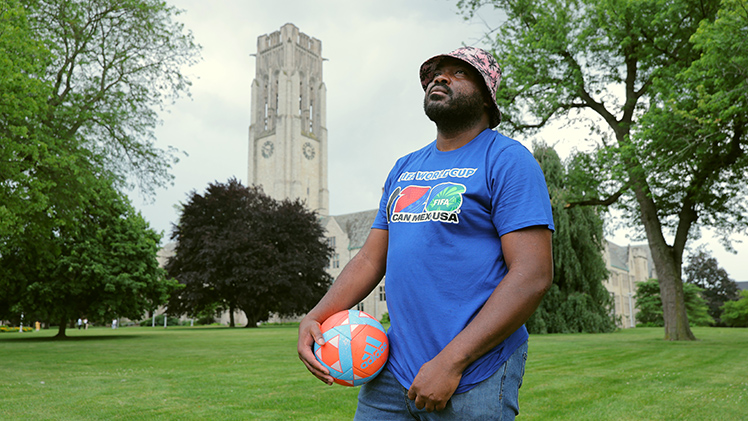
Dr. Shingi Mavima is a lifelong soccer fan and an assistant professor of history at UToledo.
Mavima is a lifelong devotee of the sport, as he describes in “Pashena,” the novel he published in 2018. “Pashena” reflects his upbringing in Zimbabwe, including the way that he and his peers made sense of their world through games on their community’s dirt field — or pashena in the native language Shona — and the way that the international men’s competition became a quadrennial timestamp for some of their most formative memories.
But his interest extends beyond the personal and into the professional.
As an assistant professor of history at UToledo, Mavima draws on his doctoral research into popular cultural expressions of identity in southern Africa. One prominent expression is sports, with major events like the Olympics and World Cup not only bringing the global community together amid bouts of nationalistic pride but serving as platforms in which countries have for decades negotiated sometimes complex geopolitical relationships.
Consider South Africa, for example, as he encourages his students to do in his history course Sports, Race and Power in Apartheid South Africa. In response to its globally criticized system of racial segregation, FIFA did not allow South Africa to send a team to the World Cup throughout most of the 1960s, ’70s and ’80s.
“We talk about that decision in class,” Mavima said. “Who took the lead in the campaign to ban South Africa? And what were their motives?”
Mavima, who has traced African participation in the World Cup from 1934 to 2022 on his YouTube channel Pan-African Conversations, also points to the beyond-the-stadium significance of a 2002 match-up between France and Senegal — a first-time nation besting the defending champion, a former colony defeating its former colonizer.
“For Senegal to defeat France in the opening match was almost hard to believe,” he said.
And he’s keeping an eye on the geopolitical stories that will no doubt emerge in this year’s World Cup, which is already making headlines surrounding the participation of Iran and unequal access to visas for international fans to enter the United States.
“There’s always a story when it comes to the World Cup,” Mavima said.
He’ll be paying attention — both to the matches and the bigger stories they tell.
“I’m particularly excited for the Democratic Republic of Congo,” he said. “They haven’t been in the World Cup since 1978, so it’s great to have them back. One of the other countries I’m rooting for is Cape Verde, which is in its first World Cup. And I’m excited to see what Haiti does.”
“But other than that?” he said. “I’m really just rooting for the game.”
