
Harmful algal blooms are not all the same.
That’s true even of the blooms within northwest Ohio, where researchers have long known that the strain of cyanobacteria that typically dominates blooms in the western basin of Lake Erie differs from the strain of cyanobacteria that typically dominates blooms more than 100 miles south in Grand Lake St. Marys.
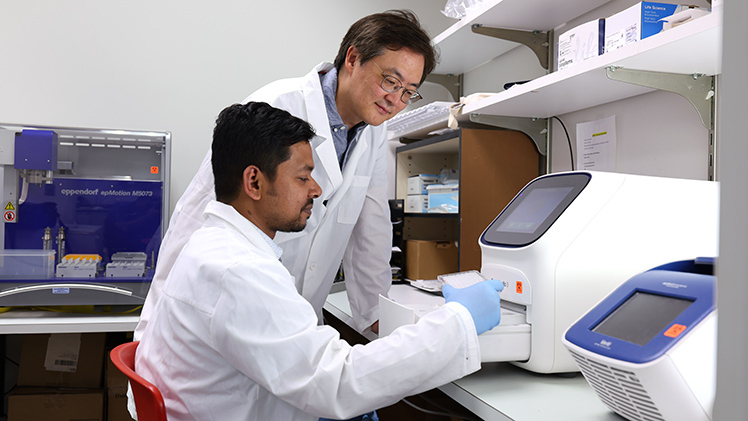
Dr. Dae-Wook Kang, an associate professor in the Department of Civil and Environmental Engineering, and Mashuk Siddiquee, an engineering doctoral student, employ multi-omics and molecular techniques to study harmful algal bloom dynamics.
New University of Toledo-led research breaks ground in zeroing in on the latter. In analyzing the microbial interactions at play as planktothrix-dominant blooms developed on the 13,500-acre lake in 2021 and 2022, Dr. Dae-Wook Kang, an associate professor in the Department of Civil and Environmental Engineering, and his collaborators identified a promising biomarker for early bloom detection.
Their research is published in the peer-reviewed journal Water Research.
“We discovered a negative correlation between planktothrix and a photosynthetic purple non-sulfur bacterium, rhodobacter,” said Mashuk Siddiquee, an engineering doctoral student who led the research under Kang. “That means, when planktothrix levels are low, rhodobacter levels are high, and vice versa. Rhodobacter also shows a negative correlation with cyanotoxin (microcystin) concentration and the abundance of the toxin-producing gene, mcyE. This trend was observed in six consecutive seasons, suggesting we could test rhodobacter levels for early indications of a planktothrix-dominant algal bloom.”
Kang is one of three water quality researchers whom the U.S. Army Corps of Engineers tasked with developing enhanced technology for early detection and management of harmful algal blooms under a $1.4 million research award in 2021.
Each one brings a different area of expertise to the project.
Dr. Youngwoo Seo, who leads the three-year project as principal investigator, explores nature-inspired biological treatment methods coupled with algaecides as a professor in the Departments of Civil and Environmental Engineering and Chemical Engineering, while Dr. Thomas Bridgeman leads efforts to monitor and predict harmful algal blooms in the western basin of Lake Erie as a professor of ecology and director of the UToledo Lake Erie Center.
Kang, for his part, brings expertise in multi-omics and molecular techniques to his investigation of the microbiomes of harmful algal blooms in Grand Lake St. Marys, Lake Erie and across the regional watershed: How do microbes interact as a bloom develops and dissipates?
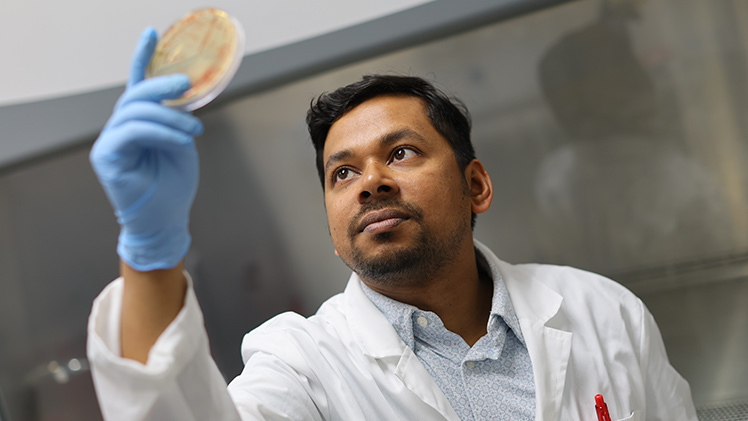
Mashuk Siddiquee, an engineering doctoral student, looks at a rhodobacter culture plate.
Planktothrix is a part of the microbiome of harmful algal blooms even in western Lake Erie, where pea-green surface sludge typically belies the dominance of the cyanobacteria strain known as microcystis. But Kang, in his recently published research, was interested in planktothrix-dominant blooms that are less visible at deeper depths, as planktothrix’s adaptability and persistence present significant risks to aquatic environments and water quality.
With that focus, he and his co-authors — Siddiquee, Bridgeman, Seo and Sara Cornelius, who has since earned a bachelor’s degree at UToledo, as well as Dr. George Bullerjahn of Bowling Green State University and Mike Sudman Jr. of the Celina Water Treatment Plant — turned their attention to the planktothrix-dominant bloom of Grand Lake St. Marys as a model ecosystem.
By using multi-omics tools to analyze samples collected biweekly from the Grand Lake St. Marys from May 2021 to July 2022, the researchers documented significant insights into the microbial interactions that regulate planktothrix-dominant blooms. The dynamics of symbiotic and competitive networks among bacteria and fungi, tied to nitrogen and carbon cycling, may support bloom longevity and toxin generation.
They were also intrigued to observe that the season’s bloom began with a different dominant strain of cyanobacteria called dolichospermum in 2021. It was eventually taken over by planktothrix.
But their most significant takeaway came in identifying the negative correlation between rhodobacter and planktothrix. The team is continuing research to validate the biomarker and better understand its interactions with planktothrix, with an eye toward the development of a quick-detection technology to flag an emerging bloom.
“Harmful algal blooms are increasing in frequency and duration around the world,” Kang said. “What we’re finding at Grand Lake St. Mary’s can help us to protect watersheds in northwest Ohio and can also be transferrable globally in regions where planktothrix blooms are threatening water resources and ecosystem health, thereby supporting efforts to secure safe drinking water supplies.”
