
Dr. James Willey, a pulmonary physician at UToledo Health and holder of the George Isaac Chair In Cancer Research, has received a $200,000 Stand Up To Cancer grant to support a simple, noninvasive screening test for lung cancer. The grant, in collaboration with investigators at the Fred Hutchinson Cancer Center in Seattle, will fund continued work on the test developed in Willey’s lab that could identify patients at elevated risk for lung cancer before symptoms ever appear.
“Lung cancer is still the No. 1 cause of cancer death and more and more people who have never smoked or don’t have other known risk factors are being diagnosed with this deadly disease,” said Stand Up To Cancer President and CEO Julian Adams. “Cost-effective, easy-to-use options for lung cancer screening are desperately needed.”
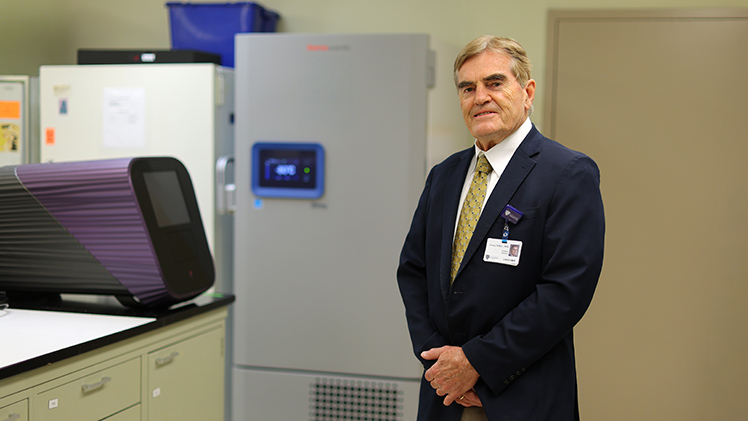
Dr. James Willey’s $200,000 grant will fund clinical validation of a ”desperately needed” screening tool that could one day be administered during a routine doctor’s office visit.
Willey’s research centers on TP53, a gene that when mutated signals elevated cancer risk. His lab has spent more than 15 years developing methods to detect pre-neoplastic lesions, which are microscopic colonies of abnormal cells that grow faster than surrounding tissue because of the TP53 mutation.
“A preneoplastic colony starts very small, you can’t even see it, but it’s a group of cells that grow faster than other cells because they have that TP53 mutation,” Willey said. “The more of those colonies we find, the higher the risk for cancer.”
The test currently measures those colonies from cells collected directly from the lungs, a procedure that requires bronchoscopy. The goal of the Stand Up To Cancer-funded research is to validate whether the same measurement can be taken from a simple nasal brush, making it far more accessible and noninvasive.
“It’s not only easier for the patient and safer, but it costs a lot less money and takes less time,” Willey said. “It can be done in the doctor’s office during a routine visit. It’s easier than drawing blood.”
The clinical validation process will compare nasal brush results against confirmed clinical diagnoses, testing the biomarker against specimens from patients with known lung cancer as well as those without, to determine how accurately it identifies those at risk. Specimens already collected through Vanderbilt University Medical Center via National Cancer Institute funding will serve as the foundation for that work, with the team at Fred Hutchinson performing the analysis on diagnostic equipment already in use in clinical settings.
Lung cancer’s silent nature makes early detection critical. Unlike skin cancer, which is visible, lung tumors can grow undetected for years before causing pain, coughing or other symptoms.
“Having methods to detect it early, to screen for it, is important,” Willey said. “The annual CT scan of the lungs is very effective, but it’s not perfect. A simple nasal brush test in the office could help direct the people at highest risk to get their screening.”
The research is part of a broader early detection effort at UToledo Health’s Eleanor N. Dana Cancer Center and falls under the umbrella of the mission of the Northwest Ohio Cancer Research Institute, launched earlier this year by The University of Toledo.
