
The University of Toledo has long been participating in a multi-agency initiative to remove grass carp from local waterways, dispatching strike teams nearly every day of the week to identify the invasive species along the Maumee River and Sandusky River.
New UToledo-led research published in the Journal of Great Lakes Research suggests these efforts are paying off in an increased mortality rate — a promising observation for those concerned about the economic and environmental threat these fish pose.
“I’m cautiously optimistic,” said Dr. Christine Mayer, a professor of ecology and expert in aquatic ecology based out of the UToledo Lake Erie Center. “We’re glad to see that there’s a positive relationship between how many fish we remove and their mortality rate, but we can’t say yet that we’ve increased the mortality rate enough to crash the grass carp population. We still have more work to do.”
Grass carp are a point of concern for ecologists because of their appetite for aquatic plants, which are critical in supporting native wildlife habitats and improving water quality in the tributaries and wetlands surrounding Lake Erie. Because grass carp mature early and spawn multiple times each year, their populations are poised for rapid growth and could quickly harm the ecosystem.
UToledo has long been engaged in efforts to identify and remove them from local waterways, in line with a broader expertise in water quality research that ranges from harmful algal blooms to salt pollution.
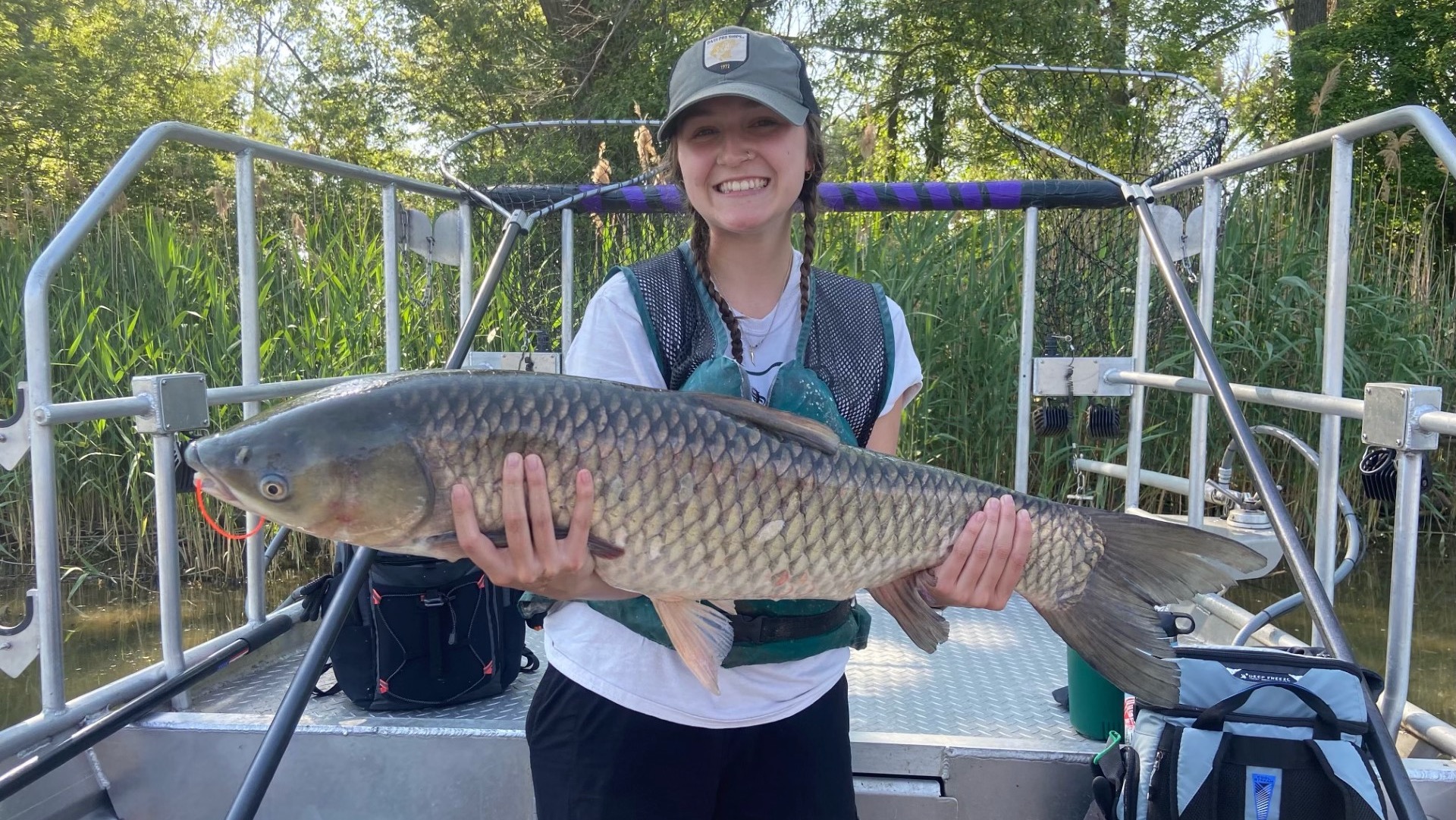
Shelby Adkins shows off her catch as part of as part multi-agency initiative to remove grass carp from local waterways. Adkins graduated with a bachelor’s degree in environmental sciences in 2024.
UToledo researchers were the first to document proof of the grass carp spawning in the Sandusky River in 2015 and in the Maumee River in 2017. Teams of research technicians and graduate students, supported by the Ohio Department of Natural Resources Division of Wildlife and the Great Lakes Fishery Commission, have been navigating the same rivers since 2019 in search of grass carp that they remove, euthanize and analyze.
Kaitlen Lang, who led the recent research in the Journal of Great Lakes Research, led the UToledo research team before she graduated with a master’s degree in ecology and organismal biology in 2022. Lang now works for the National Oceanic and Atmospheric Administration Fisheries’ Office of Protected Resources.
Lang and her collaborators wondered if the strike teams, which are supported by agencies across Ohio and Michigan, are removing enough grass carp to have a measurable effect on the population.
To date ecologists have looked to the number of fish they remove annually as their primary measure of progress, even as they recognize that these figures don’t necessarily reflect how their efforts are affecting the overall grass carp population.
So with the support of her co-authors — Mayer, Dr. Song Qian and Dr. William Hintz of UToledo and representatives from the U.S. Geological Survey, U.S. Fish and Wildlife Service, Great Lakes Fishery Commission and Ohio and Michigan Departments of Natural Resources — Lang established a new metric to measure progress by quantifying mortality rates using a hierarchal catch-curve model based on catch-at-age data from 2014 to 2022.
The model shows a positive correlation between removal efforts and mortality rates, with the annual average mortality rate rising in line with increases in the number of fish removed each year. Mortality reached a high of 13.6% in 2021.
“At a very simplistic level what we’re looking at is the decline of older fish,” said Qian, who specializes in environmental and ecological statistics. “We’re counting how many 5-year-olds, how many 6-year-olds, how many 7-year-olds there are and tracking a downward trend, which translates to the mortality rate. Kaitlen’s work shows that the mortality rate is increasing every year since the removal process started.”
UToledo continues its research on grass carp, including at what point the mortality rate will be high enough to crash the local population and how their insights can inform management of other invasive carp species in the United States.
In the meantime, strike teams, including those that set off from the Lake Erie Center, remain hard at work removing grass carp from the waterways around Lake Erie.
“Last year we introduced nets that are a passive gear that we leave out overnight, which have had good catch, and we have an inflatable raft that can go into riffles now,” Mayer said. “We’re trying to get into different places and use new methods to keep the catch up.”
