
For Sampriti Senapati, a first-semester neuroscience course at The University of Toledo proved transformative.
The Neuropsychiatric Patient introduces a variety of nervous system and psychiatric disorders to undergraduate students studying neuroscience — primarily through in-class interviews with patients navigating their symptoms.
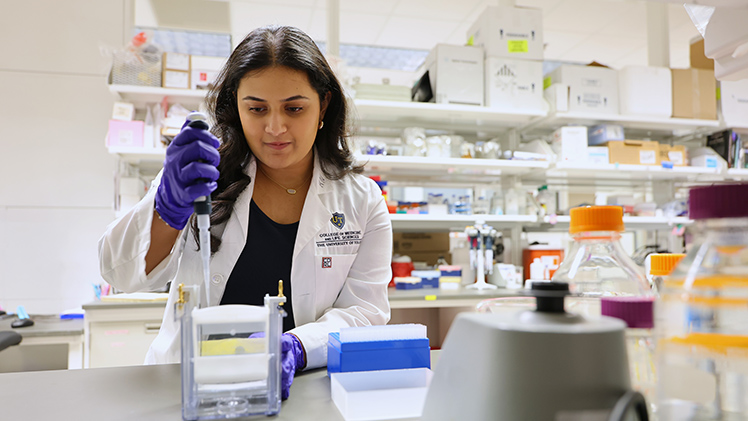
Sampriti Senapati, a neuroscience senior, researches the role of Calcium/Calmodulin-Dependent Protein Kinase II (CAMK2) in Alzheimer’s disease under Dr. Robert Smith, a professor and chair of the Department of Neurosciences and Psychiatry in UToledo’s College of Medicine and Life Sciences.
It inspired the aspiring physician to further class discussions during office hours with Dr. Robert Smith, who in turn encouraged her to pursue her interest through research at UToledo’s College of Medicine and Life Sciences. Now on the cusp of her final undergraduate semester as a Rocket, Senapati finds herself contributing foundational data to federally funded research that aims to make new inroads into how we understand and ultimately treat one of the neurodegenerative diseases presented in her first-semester course.
She isn’t one to overlook the significance of the opportunity.
“UToledo is probably the best place I could have chosen as a student,” said Senapati, one of 43 students whose research is currently supported by the Office of Undergraduate Research’s Summer Research and Creative Activities Program. “It’s a small community, which makes opportunities more accessible compared to larger schools. But I think the biggest thing is that it’s been really easy for me to get hands-on experience early on. I didn’t have to wait until I was a junior or senior here — having had literally no prior wet-lab research experience, I was able to get experience in very impactful research.”
UToledo is a Carnegie R1 institution that champions opportunities for undergraduate research — a significant category of the experience-based learning opportunities that three-quarters of undergraduate students already pursue and that will be a requirement for all incoming undergraduate students beginning this fall under a new University-wide initiative known as Applied Skills for Career Experience, Networking and Development (ASCEND).
Experiential learning opportunities were a key attraction for Senapati, who applied to UToledo from Plano, Texas. She found a perfect fit in the neuroscience degree program that uniquely leverages the resources of the College of Natural Sciences and Mathematics and the College of Medicine and Life Sciences.
Students begin their academic journeys in the former, building foundational scientific knowledge on Main Campus, before transitioning to the latter to dig into more advanced subjects like neuropharmacology and medical neuroanatomy on Health Science Campus.
The neuroscience degree program launched just as she was enrolling in 2023.
“I really wanted hands-on experience in neuroscience, so I was intrigued by the way that we would get to work with resources like with the Anatomage Table on the Health Science Campus,” she said, referring to the technology that allows students to explore human anatomy with highly detailed digitized human cadavers. “I love the hands-on learning of this program.”
Senapati has taken advantage of numerous opportunities beyond the classroom since her first weeks on campus. A student of the Jesup Scott Honors College, she’s worked alongside area physicians as a medical scribe, volunteered at the University of Toledo Medical Center and pursued advocacy and philanthropy as a past president of the campus chapters of MEDLIFE, Autism Advocates and the American Medical Women’s Association. She currently serves as a College of Natural Sciences and Mathematics Student Ambassador.
But it’s research that has especially stood out for Senapati, one of four campus nominees in 2025 for the Barry Goldwater Scholarship, one of the nation’s most prestigious undergraduate awards for students pursuing research careers in natural sciences, engineering and mathematics.
Senapati joined a faculty laboratory before the end of her first semester as a Rocket, with her early research exploring inflammation in relation to Parkinson’s disease — a meaningful opportunity to advance scientific knowledge of a disease whose neurodegenerative symptoms she’d seen affect her own grandmother for years, she said.
“That’s what first drew me into neurodegenerative disorders,” Senapati recalled. “Through my grandmother’s experience with Parkinson’s disease, I observed the physical symptoms of the disorder and became motivated to better understand its underlying mechanisms, hoping to change the lives of many others who live with neurodegenerative diseases.”
Meanwhile, Senapati stayed in touch with Smith, a professor and chair of the Department of Neurosciences and Psychiatry at the College of Medicine and Life Sciences. That’s in part through another course, Biomedical Publishing, through which she’s been one of four undergraduate students to learn about the scientific publishing process by serving as a student copy editor for the University of Toledo Journal of Medical Sciences (Translation).
Translation has become an unexpected creative outlet for Senapati, who contributed the digital artwork featured on the cover in February.
Senapati later shifted laboratories to conduct research under Smith, a leader in the study of Alzheimer’s disease who had recently received a $3.7 million grant from the National Institute on Aging. His objective is to explore its development and progression in a way that makes no assumptions when it comes to previous lines of inquiry that have failed to significantly advance scientific understanding or improve the lives of patients.
To that end, Senapati is currently exploring the role of Calcium/Calmodulin-Dependent Protein Kinase II (CAMK2), combining wet and dry laboratory techniques to compare post-mortem brain samples from control individuals, individuals with mild cognitive impairment and individuals who received an Alzheimer’s diagnosis prior to their death.
“Sampriti has taken advantage of the only undergraduate neuroscience major that is hosted in a college of medicine in the state of Ohio,” Smith said. “The program provides a unique premedical experience with access to translational research laboratories. Sampriti has clearly found a home in the College of Medicine and Life Sciences at UToledo and has a very bright future, which includes presenting a first-author abstract at the Society for Neuroscience meeting in Washington, D.C., this fall.”
Senapati continues to contribute to several collaborative research manuscripts in hopes of publishing findings that advance patient care and medical research, and she plans to remain at the laboratory bench under Smith at least through her anticipated graduation in December.
Her next step? Medical school.
