
A new space observatory promising unprecedented views of the cosmos and groundbreaking insights into its enduring mysteries is advancing to the next stage of development.
And a campus astronomer had a hand in getting it there.
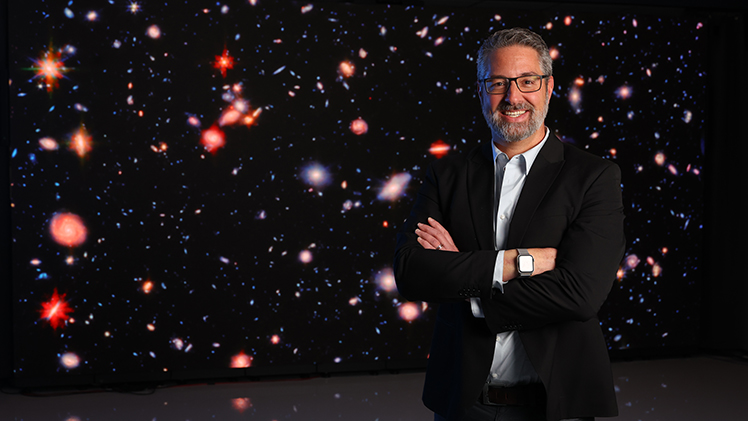
Dr. J.D. Smith is a professor of astronomy and director of the Ritter Astrophysical Research Center.
“This is the coolest thing I’ve done in my career,” said Dr. J.D. Smith, a professor of astronomy and director of the Ritter Astrophysical Research Center at The University of Toledo. “PRIMA is going to change our understanding of how galaxies and planets formed and evolved, and I’m thrilled to have been one of the scientists who helped make the case for PRIMA to the wider community.”
Smith is a co-investigator on the Probe far-Infrared Mission for Astrophysics (PRIMA), a 5.9-foot telescope that will observe in far-infrared wavelengths that bridge a gap between existing radio and infrared telescopes, including the James Webb Space Telescope.
NASA announced on Wednesday, Sept. 23, that the probe would advance to a preliminary design and technology development stage. If confirmed as ready to begin implementation, the project will move forward with a budget capped at $1.2 billion, not including launch and other non-project costs, and a targeted launch in 2033.
The first in a new class of astrophysics missions that came out of the National Academies of Sciences, Engineering and Medicine’s 2020 Decadal Survey, PRIMA is expected to answer questions about the origins of planetary atmospheres, the interplay between stars and black holes, and the buildup of interstellar dust and metals in galaxies over cosmic time, among numerous other topics.
“The PRIMA mission is humanity’s next window into the deep universe,” said Nicky Fox, associate administrator for the Science Mission Directorate at NASA Headquarters in Washington, in a statement. “It will unveil the obscure across cosmic time to better understand the formation of planets, stars, black holes and even how water on Earth came to be.”
As an astronomer who studies interstellar material as a means of understanding how galaxies evolve, Smith is well positioned to appreciate the powerful potential of the new probe. He shared these insights as a member of the science team that helped to develop the mission concept study that was solicited and reviewed by NASA.
Within this international science team of about 25 astronomers, Smith specifically co-led the key science program that will chart the rise of heavy elements like nitrogen, oxygen and carbon nanoparticles. Their work began in 2022 and culminated in May, when the science team and other stakeholders presented a detailed case for the practical and scientific potential of their proposed probe over one high-intensity week at NASA’s Jet Propulsion Laboratory, which will manage the mission for the agency.
“The potential for scientific discovery is enormous in part because the technology has advanced so far since we last had far-infrared capabilities in space with the Herschel Space Observatory and Spitzer Space Telescope,” said Smith, who began his career working on these two prior observatories that retired in 2013 and 2020, respectively. “This range of wavelengths is challenging to observe, particularly as we push farther and farther into the universe and earlier and earlier in time, so I’m incredibly excited to see what we will do with PRIMA.”
While Smith will have ready access to the probe as a co-investigator, PRIMA is also expected to host a robust general observer program. Much of its five-year mission will be allocated for observing programs led by astronomers who submit proposals in a competitive process similar to that of the James Webb Space Telescope.
UToledo astronomers have proven especially successful at the latter, with three graduate students joining five faculty astronomers in leading 12 observing programs on the powerful infrared space telescope since its launch in late 2021.
Smith said he expects PRIMA to open further opportunities to researchers at UToledo’s Ritter Astrophysical Research Center.
“Our students are going to have many, many opportunities to get involved with PRIMA,” he said. “Quite a few of our astronomers specialize in understanding galaxy evolution, which holds exactly the sort of mysteries that this probe can solve. I expect that PRIMA will have a major impact on astronomy in Toledo.”
