
A new discovery has astronomers rethinking what they thought they knew about the atmospheres of celestial bodies beyond our solar system.
The University of Toledo’s Dr. Michael Cushing and Dr. Sam Beiler are part of the international team, led by the University of California San Diego, behind the detection of phosphine in the atmosphere of a brown dwarf they call Wolf 1130C using observations obtained with the James Webb Space Telescope (JWST).
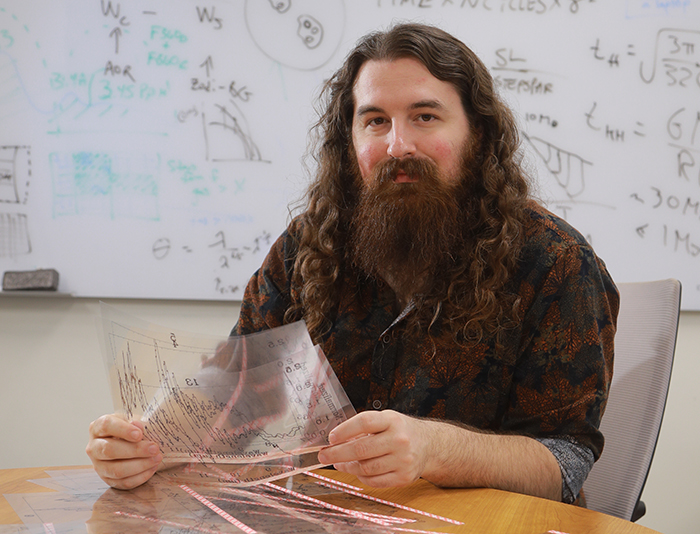
Dr. Sam Beiler recently graduated from UToledo with a doctorate in physics with a concentration in astrophysics and is now a postdoctoral scholar at Trinity College Dublin.
Their work is described in the peer-reviewed journal Science.
Phosphine has long been of interest to astronomers as a possible biosignature for anaerobic life. The team behind the most recent detection of the gas is less mystified by its presence on Wolf 1130C, which aligns with theoretical predictions, than they are by its absence in other brown dwarf and gas giant exoplanet atmospheres.
“Prior to JWST, phosphine was expected to be abundant in exoplanet and brown dwarf atmospheres, following theoretical predictions based on the turbulent mixing we know exists in these sources,” said Beiler, who recently graduated from UToledo with a doctorate in physics with a concentration in astrophysics and is now a postdoctoral scholar at Trinity College Dublin. “Every observation we’ve obtained with JWST has challenged the theoretical predictions — that is until we observed Wolf 1130C.”
Beiler and Cushing, a professor of astronomy at UToledo who was Beiler’s advisor, brought to the team valuable experience in phosphine detections on brown dwarfs.
Brown dwarfs are starlike objects with too little mass to sustain nuclear fusion. Cushing was part of a team of astronomers who discovered the coolest class of brown dwarfs in 2011, and Cushing and Beiler more recently have been gleaning new insights into these bodies using the advanced capabilities of JWST.
The latter includes groundbreaking research they led and published in the Astrophysical Journal in 2024, which demonstrated a major discrepancy between the abundances of phosphine and carbon dioxide that was detected by the new telescope and that was predicted by theoretical models in the atmospheres of four brown dwarfs. When compared to the abundances of each that were actually detected, the models were predicting too much phosphine and too little carbon dioxide.
That’s what makes the recent detection so intriguing: On Wolf 1130C, unlike on other brown dwarfs, the team of astronomers found that phosphine was present at the predicted theoretical abundances of about 100 parts per billion.
The team considered several possible explanations for the difference in phosphine on this brown dwarf compared to other brown dwarf and gas giants in the latest Science research. Each opens a door to further research to advance our understanding of phosphine chemistry — a worthwhile endeavor, according to Dr. Adam Burgasser, who led the team as a professor of astronomy and astrophysics at University of California San Diego.
“Understanding phosphine chemistry in the atmospheres of brown dwarfs where we don’t expect life is crucial if we hope to use this molecule in the search for life on terrestrial worlds beyond our solar system,” Burgasser said.
Astronomy is an area of research excellence at UToledo, where faculty and student researchers routinely engage with some of the most advanced terrestrial observatories and space-based telescopes in the world at the Ritter Astrophysical Research Center. That includes leading at least one research project on each cycle of scheduled observing time on JWST since it launched in December 2021.
UToledo astronomers’ work supports the University’s prestigious Carnegie R1 Classification announced in February. UToledo is one of only 187 higher education institutions in the country recognized for very high research activity by the Carnegie Classification of Institutions of Higher Education.
