
UToledo Health is now offering transcranial magnetic stimulation, an advanced, noninvasive therapy for treating major depressive disorder — particularly in patients who have not found relief through other treatment methods.
Transcranial magnetic stimulation, or TMS, uses targeted pulses of magnetic energy to stimulate electrical activity in the brain. Over time, that stimulation helps nudge the brain to form new neural connections, regulating brain activity and reducing depressive symptoms.
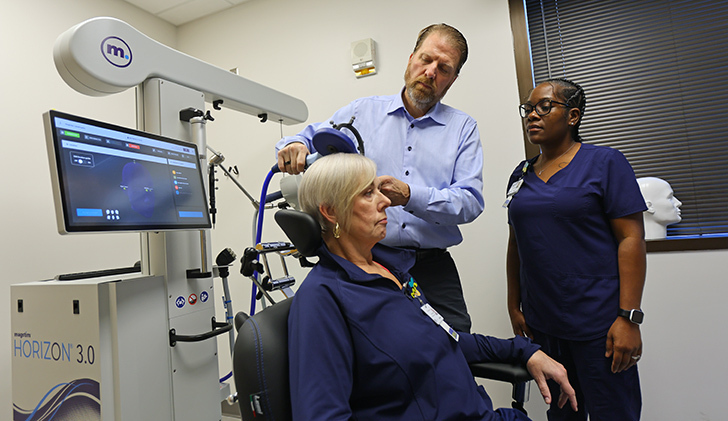
Dr. Robert Smith, center, a UToledo Health psychiatrist, demonstrates UToledo Health’s new transcranial stimulation therapy machine with TMS clinical coordinator Michelle Harris, seated, and Rosalyn Morehead, the outpatient clinical supervisor for psychiatry.
The FDA-approved outpatient therapy, which is performed daily over the course of several weeks, requires no sedation or other special preparations and is generally well-tolerated by patients.
Upwards of 20 million Americans suffer from at least one major depressive episode every year, and roughly one in five people will experience major depression at some point in their lives.
“Depression is more than a period of sadness. It’s a significant health problem that can affect every part of a person’s life. It also can sometimes be challenging to treat,” said Dr. Robert Smith, a UToledo Health psychiatrist. “Many people do get better with medication and talk therapy, but for some patients, that isn’t enough. TMS gives us a completely different way to attack the problem.”
Clinical data suggest up to a third of patients with major depressive disorder do not respond to antidepressants. However, many of those individuals do achieve a significant and lasting reduction in symptoms following transcranial magnetic stimulation therapy.
“There are a dozen things for treating depression and only one of them is medication,” Smith said. “If you’re coming in and getting treated with TMS, we also want to make sure you don’t have sleep apnea or a thyroid problem. We want to know that you’re getting exercise, sleeping well and eating a good diet. Getting better takes a holistic approach, but TMS is a great option for many patients.”
At UToledo Health, TMS therapy is available to patients 18 and older. The treatment is covered by most major insurers, including Medicare, but is typically approved only after a patient has not adequately responded to other treatments, such as medication and psychotherapy. Referrals are required.
The magnetic pulses used in TMS are similar to those generated by MRI machines. However, instead of creating detailed images of a patient’s bones and organs, the energy is precisely focused to stimulate specific brain circuits involved in mood regulation.
During treatment, patients are seated in a cushioned chair that resembles a barber’s recliner and an electromagnetic coil is placed against the left side of their head. Prior to the first session, the patient’s brain is mapped to find the correct location, and the provider works to dial in the right amount of energy to properly stimulate brain activity.
The therapy itself usually takes between 15 and 45 minutes, during which time patients will feel a tapping sensation on their scalp. Some patients do experience headache or nausea, particularly early in treatment, but significant side effects are rare.
“Most patients do really well with TMS, and we’re excited to be able to offer this new therapy in an academic medical setting,” Smith said. “For the right patients, it’s something that can move the needle and significantly improve their lives — without requiring pills or other more invasive therapies. The biggest thing is the time commitment. It takes time to help the brain rewire itself.”
Patients generally receive therapy sessions five days a week for four to six weeks, but the improvements to a patient’s mental health, particularly when paired with other interventions like ongoing therapy and lifestyle changes, can last a year or more.
Individuals interested in learning more about transcranial magnetic stimulation at UToledo Health can call 419.383.5695 and select option 2.
