
Shawn Monteiro has helped raise over $10,000 for charity and clinically care for hundreds of patients in need, but the most impactful of his accomplishments as a Rocket may be years away from aiding anyone.
After all, medical device patents are not granted overnight.
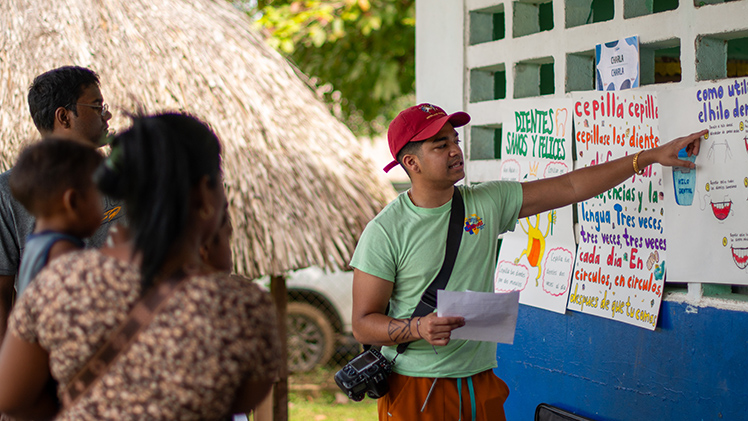
Shawn Monteiro has helped raise over $10,000 for charity and clinically care for hundreds of patients in need including on a trip to Panama last January.
The Bioengineering senior and Jesup Scott Honors College student is, however, well on his way to achieving that rigorously evaluated distinction. Monteiro’s prototype for immobilizing hands during a surgical operation has already secured provisional patent status.
“This process has involved months of communication with industry experts, UToledo’s Technology Transfer Office and patent lawyers,” he said. “I expect to apply for the utility patent in February and am currently exploring licensing opportunities to eventually bring the device into surgical practice.”
Orthopaedic surgeons currently rely on an instrument that looks like an enlarged, flattened blue glove sporting extra digits. These metallic appendages are constructed from firm yet flexible aluminum and can wrap around a patient’s wrist and fingers to secure the hand in a particular position during a delicate operation.
Unfortunately, this current market leader often allows patients’ fingers to slip mid-surgery. Physicians must then be careful to avoid inadvertently severing a tendon or causing other injury when this occurs. The tool also is restricted to a single use, leading to higher costs for hospitals and patients as well as increased amounts of medical waste.
Monteiro’s “Plate-and-Strap Hand Immobilizer” improves upon this prevailing product by accommodating multiple hand positions, a range of patient anatomies and each physician’s preferred surgical technique. It also can be utilized repeatedly, making it a cheaper and more sustainable option.
The idea was born out of Monteiro’s participation in the University of Toledo Medical Center’s Clinical Immersion Co-op Program. This unique opportunity allowed him to rack up more than 400 hours shadowing physicians such as Dr. Abdulazim Mustapha, an associate professor of orthopaedic surgery. It also connected him with other faculty such as Dr. Martin Skie, a professor of orthopaedic surgery and chair of the department, who similarly provided Monteiro feedback on his idea.
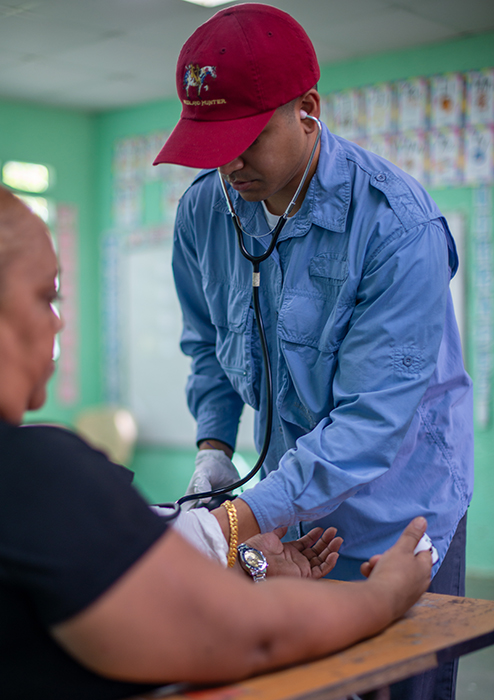
Partnering with volunteer physicians, dentists, translators and other staff, Shawn Monteiro and his Rocket peers in UToledo chapter of Global Medical Brigades have supported triage, general medical, pharmacy and even children’s educational services in Panama and Honduras.
“This co-op project became more than a simple design challenge,” Monteiro remarked. “As a learning experience, it has shown me that change does not always begin with sweeping reform; it can start with a single frustration, noticed by someone willing to act.”
After watching Dr. Mustapha’s struggles with the existing equipment, Monteiro investigated secondary complications encountered by patients recovering from hand procedures at UTMC. Once he understood all the shortcomings that an alternative instrument should avoid, he researched the material constraints and federal regulations that would need to be observed in its design.
Several notebook sketches of ideas followed before Monteiro eventually modeled his invention with computer-aided design software and 3D-printed a prototype. When he returned to the co-op to solicit feedback from his mentors, he was delighted by their response.
“Shawn was able to appreciate the challenges he observed in the operating room and was driven to create a novel solution that addressed them,” Mustapha said. “He thus demonstrated excellent problem-solving abilities and was able to critically apply his knowledge.”
Monteiro’s appreciation for all that is possible in spite of the status quo, however, offers more than a boost to clinical outcomes that is patent pending. This Rocket has already inspired hope for hundreds on the global stage and in the Toledo region through his philanthropic and humanitarian work.
Through his role as vice president of programming for Sigma Phi Epsilon, Monteiro has led fundraising efforts at philanthropy dinners and annual events such as the SigEp x Triangle Haunted House that have netted over $10,000 for area nonprofits. Benefiting charities have included Big Brothers Big Sisters of Northwestern Ohio, Sunshine Communities, the American Cancer Society, Mom’s House and Tent City.
The memories Monteiro made as vice president of finance for the UToledo chapter of Global Medical Brigades were no less cherished, if decidedly more poignant.
He traveled with the group to Panama for a week over winter break earlier this year and to Honduras in 2024 to care for hundreds of underprivileged patients — some of whom had to travel dozens of miles by foot to reach the clinic. Partnering with volunteer physicians, dentists, translators and other staff, Monteiro and his Rocket peers supported triage, general medical, pharmacy and even children’s educational services.
“It was eye-opening to see how little access to care these patients enjoyed,” he said. “Many have no hospital within reach and, if they do, it is often private and only caters to the rich. The few public hospitals are overflowing, provide substandard care and work their staff past exhaustion.”
While his bioengineering training certainly came in handy on the trips, Monteiro’s avid photography skills also were relied upon by the group.
“I was able to document the great work we were doing but also capture raw, unposed moments that demonstrated the severe conditions our patients were subject to,” Monteiro said. “Serving as photographer on both trips also led to me being featured heavily in the national organization’s social media, thus allowing me to expand UToledo’s impact well beyond our city and show others how we are influencing the world around us.”
Though he is fast approaching graduation next fall, with plans to then attend medical school, Monteiro intends to continue raising the University’s institutional profile through his humanitarian work and cutting-edge research for years to come.
“UToledo students enjoy unparalleled opportunities to grow and contribute as practicing professionals even before their careers officially begin,” said Mary Humphrys, associate vice provost for academic affairs. “I’m proud to see Honors Rockets like Shawn leading the way to a brighter tomorrow for all of us through their discovery and service.”
