
Now thousands of miles from his home in from Bhaktapur, Nepal, Sachin Aryal’s journey to The University of Toledo and into the Ph.D. Molecular Medicine Program began with a conversation.
“I communicated with one of my seniors from Nepal who was pursuing a master’s degree in bioinformatics at UToledo,” Aryal said. “Through her, I got to know more about the program and I found it very interesting. Then I applied and got selected with a full scholarship and stipend, which made it easy for me to select UToledo as my college.”
CELEBRATING SUCCESS: UToledo recognizes the Class of 2025 with a series of stories featuring students receiving their degrees at fall commencement.
Set to graduate Saturday, Dec. 13, with his Ph.D. in molecular medicine, Aryal said his first interest in health science was sparked by his mother, who was a nurse.
After earning his undergraduate degree in Nepal, though, Aryal said he felt the need to come out of his comfort zone and explore new places as he earned a higher degree in biology.
“I am the youngest in my family and my parents were initially hesitant to allow me to live thousands of miles away from home on my own,” Aryal said. “But I insisted and came to the U.S. to pursue higher education. Today, they stand tall and proud.”
Aryal started at UToledo with a background in computational bioinformatics which required a leap to transition into molecular medicine. Aryal said it was his greatest challenge to navigate between the two fields but ultimately became his greatest success, earning him a multitude of awards and recognitions.
“By bridging bioinformatics and molecular medicine, I contributed to 16 high-impact publications to date, including first-author papers in Hypertension and American Journal of Physiology–Cell Physiology,” he said. “I also secured a prestigious American Heart Association Predoctoral Fellowship and was honored with Research Recognition Award from the American Physiological Society (APS).”
Aryal also was selected as a fellow of the APS Early-career Advocacy Fellowship for two years where he worked with science committee members in Capitol Hill, building a science advocacy toolkit for empowering other scientists to communicate clearly, influence policy, build public trust and inspire collaboration.
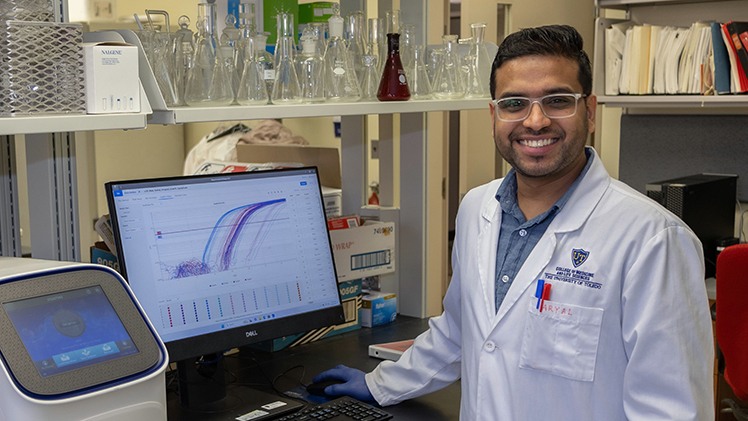
With multitude of awards and recognitions for his field work bridging bioinformatics and molecular medicine, Sachin Aryal graduates Dec. 13 with his doctorate in molecular medicine.
“At UToledo, I had ample opportunities to not only hone my research and leadership skills but also to represent my University on national platforms through my involvement in the American Heart Association and APS, where I was invited to serve on various committees,” Aryal said. “As a president of CBGS at UToledo, among other events, me and my team organized a Graduate Research Annual Forum to provide a platform for biomedical science students to present their research. These experiences have strengthened my sense of responsibility and inspired me to continue contributing to my community and improving the lives of others.”
Dr. Bina Joe, a Distinguished University Professor and chair of the UToledo Department of Physiology and Pharmacology, said working with Aryal has been a pleasure.
“Sachin came to me full of ‘potential energy,’ which was easy for me to convert into ‘kinetic energy’ because he had the necessary zeal and passion,” she said. “His approach to research with persistence, creativity and attention to detail along with his positive attitude, leadership skill and collaborative spirit made him grow to the well-accomplished researcher that he is today. I have no doubt that UToledo has left an indelible mark on his education by providing him with an excellent international level of exposure to both AI research and hypertension research. I wish him all the very best in his endeavors.”
Aryal said he is planning to pursue a career in clinical research in the field of cardiovascular disease after his recent move to Pennsylvania.
“Looking back, what I consider my greatest success at UToledo is not just the scientific discoveries or recognition but my ability to transform initial challenges into opportunities for growth, integrating diverse skill sets, mentoring others, and contributing meaningfully to both science and the student community via advocacy efforts,” he added.
