
I was first introduced to The University of Toledo in the fall of 2019 after my father, an alumnus of the University, gave me an informal tour of the University while in Toledo for my brother’s hockey tournament. At the time, I was a junior in high school and was looking at different universities to attend once I graduated high school. Unbeknownst to me, this would be the only “guided” tour I would have at a university because a few months later, the COVID-19 shutdown would occur.
Regardless, my father was a knowledgeable tour guide.

CELEBRATING SUCCESS: UToledo recognizes the Class of 2025 with a series of stories featuring students receiving their degrees at fall commencement.
He had nothing but positive things to say as he walked me around Centennial Mall and pointed out the different buildings and halls. I did not know it then, but a little less than two years later, I would be starting my undergraduate degree in biology at UToledo and was not aware how much it would change my career’s trajectory.
As long as I could remember, I knew I was going to study biology. My ideal careers when I was younger included veterinarian, scientist and doctor, all of which can use biology as a launching point. Even in high school, when I was still considering what path I wanted to take as I applied for college, I knew then that I wanted to start with a biology major and use that as a base and go from there. So even when I was applying to UToledo, I knew I was going to join the College of Natural Sciences and Mathematics. I remember some of my family members encouraging me to apply for bioengineering, but I was dead set on just focusing on biology. Due to COVID-19, I applied to nine universities in the fall of 2020 because restrictions prevented me from college visits. When the acceptance letters began to arrive in the spring, I was not really sure where to go, but one university accepted me for more than just admissions.
The Jesup Scott Honors college ended up being the deciding factor that had me choose UToledo over other colleges and proved to be pivotal in my academic development. The opportunities it provided while also setting high standards really pushed me to be the best possible student I could be. I always knew UToledo to be an engineering school based on what my father said, but I quickly learned that UToledo encourages students to be well-rounded, especially in the honors college. The emphasis on discussion and the interdisciplinary approach encouraged me to make connections through social sciences, arts and writing as I worked on my biology degree. The most notable effect of honors was the undergraduate research requirement which shaped my academic trajectory.
I originally wanted to study medicine and become a doctor or physician’s assistant when I began my higher education studies. My mother always told me to use my powers for good, and I thought going into medicine would allow me not only to focus on biology but also help people. It was not until I started honors research in the laboratory of Dr. Maria Diakonova [a professor in the Department of Biological Sciences] that I realized that research was my calling.
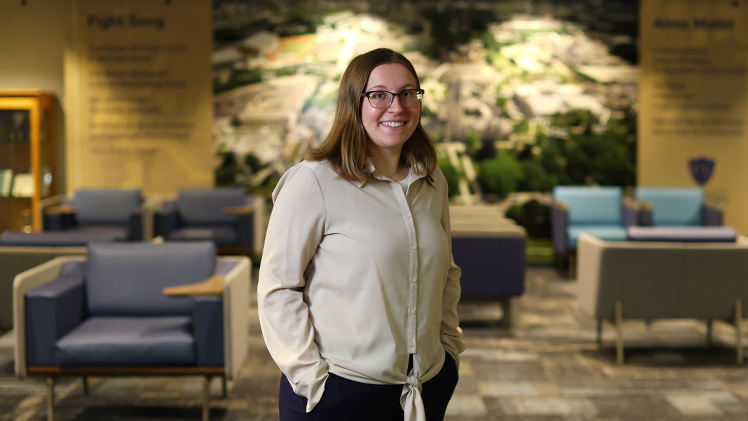
Taylor Klaiber wanted to study medicine and become a doctor or physician’s assistant. When she began her honors research in the laboratory of Dr. Maria Diakonova, a professor in the Department of Biological Sciences, she realized that research was her calling.
I joined her lab in the fall of 2023, and I became fascinated with Dr. Diakonova’s signal transduction and breast cancer research and enjoyed the hands-on approach that allowed me to work on experiments. I experienced first-hand the frustration of experiments not working until the right procedure was figured out and the excitement when it finally did produce results.
It was in the fall of 2024 when I made the decision to switch paths from a physician or physician assistant to a Ph.D. My friends, family and mentor supported my decision and helped and encouraged me to pursue my new path. Until I joined research, I was worried that I would go through medical school and training and end up being stuck in something I was not passionate about. The opportunity to do research under Dr. Diakonova not only allowed me to grow as a biology honors student but also led me down a career path that I am passionate and proud to be a part of.
In the spring of 2024, I added an environmental science minor to complement my biology major and chemistry minor. I have always had a love of nature, with vacations to national parks and a love of hiking attests to this, but I wanted to learn how to apply some of my knowledge from my biology courses to a wider scale. I enjoyed being able to see the real-world implications of certain theories and everyday-life applications that I could use to help better myself and the environment around me.
My instructors also really hit home the notion that there is not always an easy solution to problems and that it is important to investigate as many factors as possible when trying to consider one. A major lesson in this field is that everything is connected, the courses and professors encouraged me to make these connections and taught me to think of the bigger implications of certain actions and ideas.
Reflecting on my journey, The University of Toledo and its College of Natural Sciences and Mathematics and Jesup Scott Honors College provided guidance and opportunities as I worked towards my degree. The institution’s resources and supportive community enabled me to discover a new path that aligns both with my professional goals, but also my aspirations. I know my journey is not over, but I am glad that The University of Toledo with the College of Natural Sciences and Mathematics along with the Jesup Scott Honors College has been a big part of it.
Taylor Klaiber graduates from UToledo with her bachelor’s degree in biology on Saturday Dec. 13.
