
Dr. Holly Eichner, senior lecturer and director of the Recreational Therapy Program at UToledo’s College of Health and Human Services, knows that recreational therapy clicks for her students once they get out of the classroom and meet patients face to face.
“We have students who come in and say, ‘I never want to work in psych’ or ‘I never want to work with elders,’ ” Eichner said. “And then they get out there and they fall in love with it.”
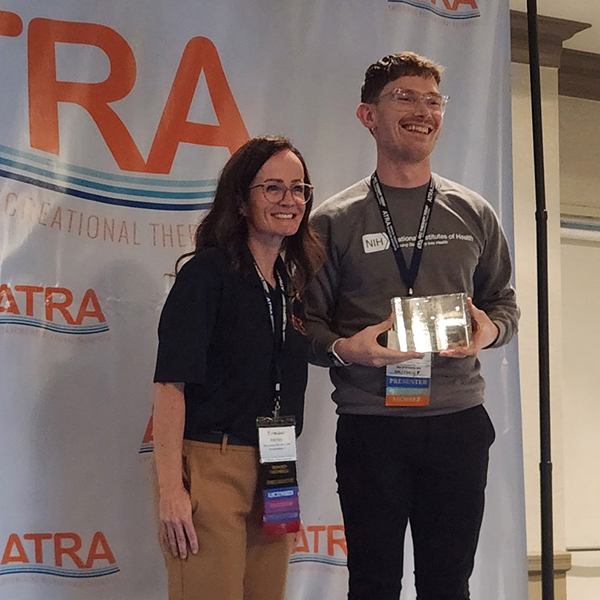
Stefan Ellington, a 2019 UToledo recreational therapy graduate, accepts the National Excellence in Education Award on the University’s behalf at the 2026 ATRA Annual Conference held on Oct 17.
The American Therapeutic Recreation Association has selected UToledo’s Recreational Therapy Program for its Excellence in Education Award, which honors programs that demonstrate outstanding preparation of students for the national credentialing examination and professional practice.
The award reflects years of deliberate curriculum work. The Recreational Therapy Program transitioned to a fully online format in 2022, a year before Eichner became program director. Under her leadership, the program also made the significant decision to switch its accreditation to the Commission on Accreditation of Recreational Therapy Education, CARTE, aligning the program with other allied health professions under the Commission on Accreditation of Allied Health Education Programs (CAAHEP) umbrella.
“We were the first recreation therapy program to be 100% online,” Eichner said. “One of the big changes we decided to make was to move over to CARTE accreditation. And through all of that, our pass rates for the national certification exam have stayed above the national average.”
Recreational therapists practice in a wide range of settings. Some work in physical rehabilitation, helping patients regain confidence and function after injury or amputation through adaptive sports and leisure activities. Others focus on developmental disabilities, behavioral health or hospice, or work for the U.S. Department of Veterans Affairs, historically one of the field’s largest employers. The therapeutic tools are just as varied, from nature-based therapy and art to music, movement and games, all guided by what matters most to the individual patient.
“Recreation therapists work across all the health domains to ensure that we’re helping the client on every avenue,” Dr. Eichner said. “We really get to sit down and engage with people with the things they’re most passionate about to help them meet their therapeutic goals.”
Graduates of the program leave with more than 700 direct client contact hours through four fieldwork rotations and a 14-week internship. The program’s experiential learning requirements predate UToledo’s recent UToledo Advantage by more than 30 years.
“You have a passion coming into it and you can take that passion in a direction to help others,” Eichner said. “And our degree teaches strong communication skills, administration skills and organization skills that can be really helpful wherever you go in healthcare.”
That career flexibility is reflected in the program’s alumni. Megan Vandyke, a 1999 graduate now working as quality-of-life coordinator at Otterbein Senior Lifestyle Choices, said the program prepared students both for the national exam and for the realities of clinical practice.
“The knowledge that the program can bring to a variety of students is instrumental in being able to see growing numbers of recreational therapists in our community,” Vandyke said. “I have personally taken many aspects of our program to reach the newest students each year they are able to join in.”
Heather Risser, a recent 2026 program graduate, said for her the teaching style made the difference.
“I felt prepared and had the knowledge I needed to pass,” Risser said. “They used real-life examples in their teaching, so when working with clients I felt prepared. I never felt like just another student. I felt valued, seen and supported.”
