
Every time an aircraft takes off, flies and lands, its metal parts flex and vibrate, sometimes millions of times over a single flight. Over years of service, that repeated stress can cause tiny cracks to form and grow inside the metal, a process known as fatigue failure.
If engineers don’t know how long a part can safely withstand that stress, they either replace parts too early, wasting money, or risk keeping a weakened part in service too long.
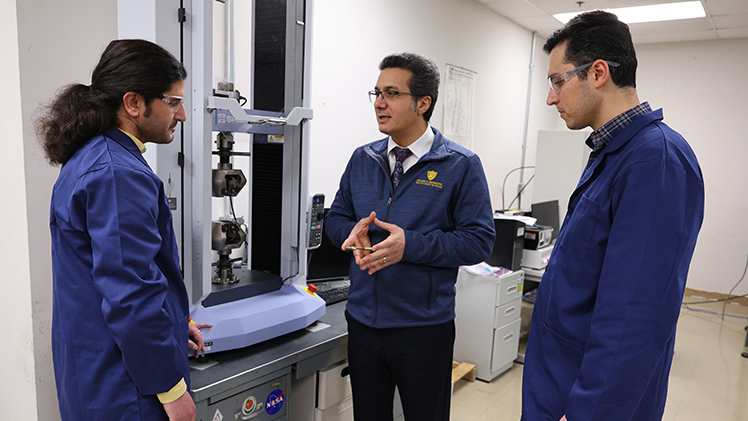
Pictured, from left, in the UToledo’s Failure, Fracture and Fatigue Laboratory, are Mohammad Mahtabi, a Ph.D. student in mechanical engineering; Dr. Meysam Haghshenas, an associate professor in the Department of Mechanical, Industrial, and Manufacturing Engineering (MIME); and Mojtaba Roshan, a Ph.D. student in mechanical engineering.
That’s where The University of Toledo’s Failure, Fracture and Fatigue Laboratory (F3L) steps in.
A new, three-year, $450,000 grant from the Air Force Office of Scientific Research (AFOSR), part of the U.S. Department of Defense, will support the lab’s work to advance methods for rapidly quantifying the fatigue life of high-strength, lightweight alloys used in aerospace applications.
The project, “High-throughput Fatigue Quantification of Aerospace Alloys,” will run from August 2026 through August 2029 and is led by Dr. Meysam Haghshenas, an associate professor in the Department of Mechanical, Industrial and Manufacturing Engineering in the College of Engineering and director of the F3L.
Two graduate students will be hired to support the new line of research using a high throughput testing method.
“Traditionally, measuring fatigue has been a slow process because it requires cycling a material millions or even billions of times to see how it holds up,” Haghshenas said. “Our research team has developed testing methods that can speed up that process dramatically, allowing us to evaluate lightweight, high-strength metals used in aircraft and spacecraft much faster than conventional approaches including under the extreme heat conditions those parts experience in real flight.”
Haghshenas’ lab houses several machines that test how materials hold up over time, but the one that sets it apart nationally is a high-temperature ultrasonic fatigue tester installed in 2024 with Defense University Research Instrumentation Program (DURIP) support.
The equipment can subject materials to extreme heat and an extremely high number of stress cycles in a short amount of time, giving Haghshenas and his students a rare, hands-on window into how tomorrow’s aircraft materials will perform.
“Our lab can rapidly show how long these lightweight metals will last under the kind of repeated stress and heat they’d face in real aerospace use. That matters for the Air Force, where lightweight parts are flexed at high frequency, over and over, in some of the harshest thermal environments imaginable,” he said. “The more precisely we understand how these materials wear out, the better we can help engineers design aircraft components that are lighter, safer and longer-lasting.”
The UToledo lab’s distinctive capabilities have already drawn interest and research funding from the U.S. Army, NASA and the National Science Foundation, and now, the Air Force, with total active grants of $1.8 million.
The new funding adds to a growing body of federally supported research in the F3L that is helping engineers better predict and extend the life of the advanced materials used in aircraft, spacecraft and defense equipment.
The work is also one of many contributors to UToledo’s reputation as a hub for high-impact research. The University of Toledo is the only R1 university in Northwest Ohio, a Carnegie Classification reserved for doctoral universities with the highest levels of research activity.
